Every expert business runs on the same five-stage customer journey: followers, subscribers, leads, deals and clients. Most owners just don't have names for the stages.
Without the names, it all blurs into one messy, hairy thing called "marketing and sales." You're posting, emailing, following up and pitching, and you can't tell which part is broken.
Once each stage has a name, the job of each one gets obvious. Your newsletter exists to turn subscribers into leads. Your follow-up exists to turn leads into sales calls. Then we can zoom into whichever stage is leaking and fix that one.
What Are the Five Stages of the Customer Journey?
Followers. People who consume your content but haven't given you their contact info. They're in your orbit, not in a database.
Subscribers. They gave you their email address. They live in your email marketing tool.
Leads. People you believe you could do business with but haven't yet. They're the first stage inside your CRM.
Deals. A sales call is booked and there's money on the table. They live in your CRM.
Clients. They bought. They live in your CRM, and they're where your next deals and referrals come from.
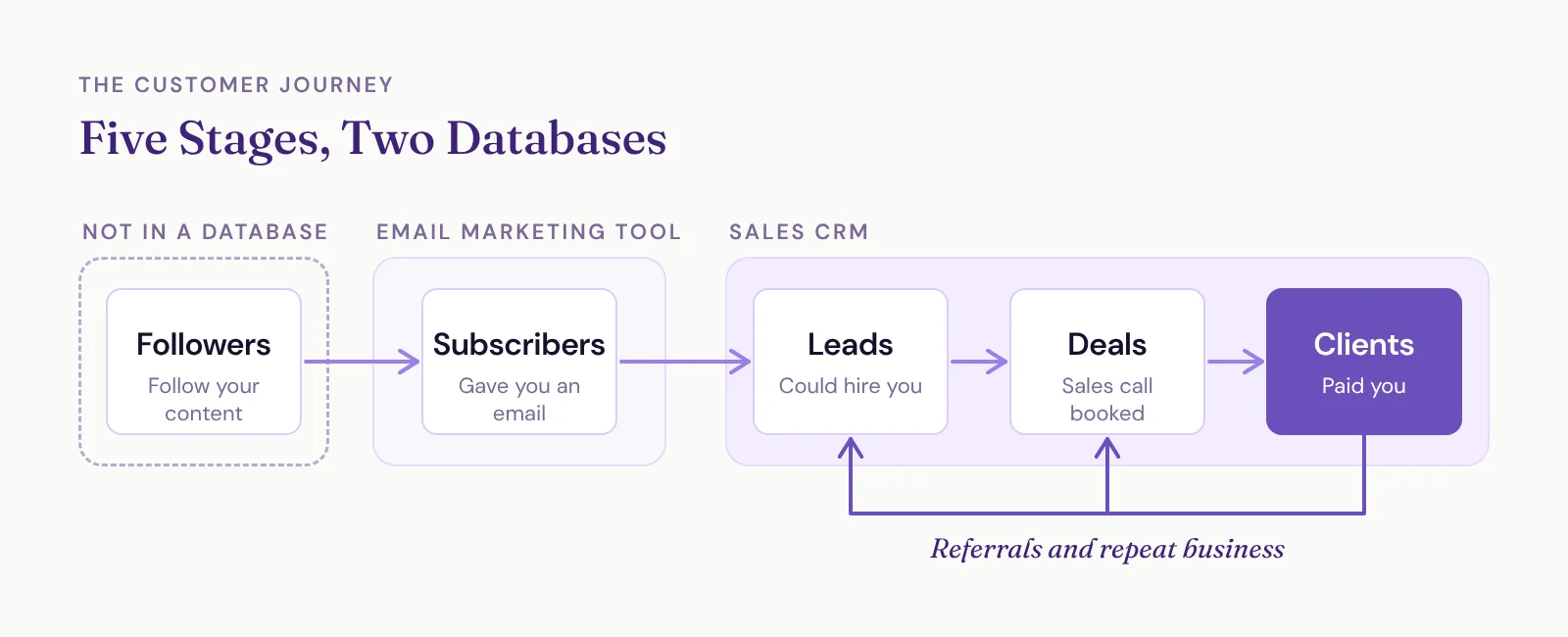
Your job at every stage is to move people one step forward. Followers into subscribers. Subscribers into leads. Leads into deals. Deals into clients. Then clients into more deals and more leads, which is what makes it a loop instead of a funnel.
People skip steps all the time. A follower might fill out your contact form and jump straight to lead. That's great. But when you're building your systems, baby step it.
Followers: In Your Orbit, Not in a Database
Followers are your LinkedIn connections, your YouTube viewers, your podcast listeners and the people who saw you on stage. They like your stuff. You just don't own their contact info, so you can't reach them on your terms.
The goal here is an email address, at a minimum. And nothing about this is specific to what you sell. A speaker, a roofer and a hairdresser all do it the same way.
Give them an offer that's worth filling out a form for. A PDF, a mini course or a webinar works, as long as it solves a problem they actually have. A text opt-in does the job too. What matters is that they hand over their info.
Subscribers: On Your List, Not in Your CRM Yet
Subscribers come in through your signup form, a download, a webinar registration or the feedback form after your talk. They live in your email marketing tool.
This is where most people get tripped up. A lot of so-called lead magnets are really subscriber magnets. Someone downloading your PDF tells you they're curious. It doesn't tell you they're a decision maker with the problem you solve and the budget to fix it.
So here's the test. Is this person now worth your one-to-one attention? If the answer's no, they're a subscriber, and your newsletter does the work. I go deeper on why subscribers don't belong in your CRM in its own post.
The job of this stage is turning subscribers into leads. That's what your newsletter and welcome emails are for.
Leads: The Goal Is a Booked Sales Call
Leads are people you believe you could do business with but haven't yet. They're the first stage in your CRM, and this whole stage is business development. Its only goal is getting a sales call on the calendar.
Leads come in two flavors, and you work them differently.
Inbound leads raised their hand. They submitted your contact form, booked a call or took a true lead magnet like an assessment. They've already done enough research to say "I want to talk to you," so your follow-up barely needs to explain anything. "You mentioned you wanted to chat. Let's get a call on the books. I'd love to hear about your event." Then nudge until they book. At least 75% of contact form leads should end up on a sales call. The 17-day follow-up plan lays out exactly when to nudge.
Outbound leads are people you've prospected. This might be the first time they've heard of you, so your outreach has to educate. The first message names a problem people in their seat tend to have and how you solve it, then asks if it's relevant right now. The next one shows proof of the work. The one after that sends something useful. The math is rougher here too. The law of averages I've always worked from is about 50 to 1. Out of 50 cold leads, maybe 10 reply positively, 3 to 5 take a sales call and one becomes a client.
Either way, most of your leads won't go anywhere. They'll be bad timing, they'll ghost, they won't be a fit. That's expected, and it's exactly why leads sit in their own bucket. Close them out with a stage instead of deleting them, and your real relationships never get buried under them.
Deals: When There's Money on the Table
A lead becomes a deal when a sales call is on the calendar and both of you know it's a sales call. Not a virtual coffee where you think it's a pitch and they think it's a chat. If someone booked time to talk about hiring you, there's money on the table.
In the CRMs we build, Meeting Scheduled is the first deal stage, at about a 10% likelihood of closing. Some people would rather run the first call before they call it a deal, and that's fine. Pick one and stick with it so your numbers mean something.
When you convert a lead, your CRM creates three linked records: the contact, the account (their company) and the deal. Until then, the lead sat on its own island. That separation is the whole point. It lets you see how well business development turns leads into deals, separately from how well sales development turns deals into clients.
Now the goal changes. You're getting the money on their side of the table over to yours. That usually starts with a solid first sales call.
The biggest problem I see with first calls is that they aren't standardized. Have a set list of questions for each thing you sell, and set an agenda right after the pleasantries:
"My goal today is to understand if I can be of service to you. That might mean working together. It might mean referring you to someone who's a better fit. At the end of our call, we'll decide if we book another call or high five and part ways."
That agenda gives you control of the conversation, and it gives them confidence that you know what you're doing. Then ask the questions that tell you if they're qualified: What's your budget for something like this? Have you hired speakers like me before? What did you like and not like? What do you want your attendees walking away with?
You're also gathering ammunition. Whatever they tell you now is how you'll handle their objections later.
Book the next call before you hang up. After that, it's another meeting, a proposal or your price on the call, maybe some negotiating, then a contract and a deposit. Most deals die somewhere in that stretch, and I break down where speakers lose deals after the first conversation in another post.
Clients: Where the Loop Starts Over
Clients are the last stage, and they're the most skipped. Speakers, coaches and consultants deliver the work, say thanks and move on.
Here's what nurturing clients actually looks like:
Ask for a testimonial once you've delivered.
Ask for referrals. "Who are three people you know who could benefit from this?" They'll often intro you right there.
Set a recurring check-in every 90 days. Say hi, send something useful and stay top of mind.
Every so often, make an offer. "I can help you with this next thing. Interested?"
Most people in our industry skip every one of those. Referrals drive most of their business, and they're still totally passive about asking. They lose touch with past clients, those clients forget about them, and there's nothing else to buy because there's no next offer.
This is the stage that closes the loop. Every client should send you new leads and new deals. If yours aren't, that's a process problem. I walk through how to ask for referrals after every gig step by step.
What Changes When You Name the Stages
One of our longest-running clients has been with us for years, and we've dialed in this whole process for him. The biggest change isn't a piece of software. He knows where to spend his time.
He puts real effort into relationships with his referral partners and bureau reps. He follows up with his clients and lands repeat business there. He works the new leads that come in. He sends his newsletter every couple of weeks and posts on LinkedIn regularly.
He isn't giving every bucket maximum effort. The labels gave him permission to put more into some stages and less into others, and that's most of what makes it sustainable.
That's what the five stages are for. Name them, figure out which one is leaking and fix that one first.