Almost everybody in this industry already knows referrals pay the bills. Almost nobody asks for them.
In our 2026 State of the Industry data, 64.7% of respondents named referrals and word of mouth as their #1 revenue channel. Nothing else comes close. And yet in our earlier State of the Industry surveys, fewer than 5% of respondents said they actually ask for referrals.
So the question isn't whether referrals work. It's what would happen to your business if you just asked, after every single gig.
Why "Waiting for Referrals" Isn't a Strategy
Here's how most speakers, coaches and consultants get referrals. They do great work, they go home, and they wait. The phone rings, an email shows up, someone says "so-and-so told me about you." Great!
That's passive. You're relying on your clients to remember you, find the right moment and figure out what to say, all on their own.
I hear a version of this on calls all the time. One speaker told me he'd asked for referrals, but only when a client was "overtly excited" about what he'd just presented. Another put it this way: "I walk away and I'm like, all right, my job's done. No, your job just started."
Neither of them was asking at the wrong moment. They just weren't making the ask as a step. It happened when the vibe was right, which means most of the time it didn't happen at all.
Flip that around. If you ask after every delivery, some clients say "nobody comes to mind," and that's fine. Some give you one name. Some give you three. Do that after every gig for a year and it compounds.
The Linear Journey vs. the Cyclical One
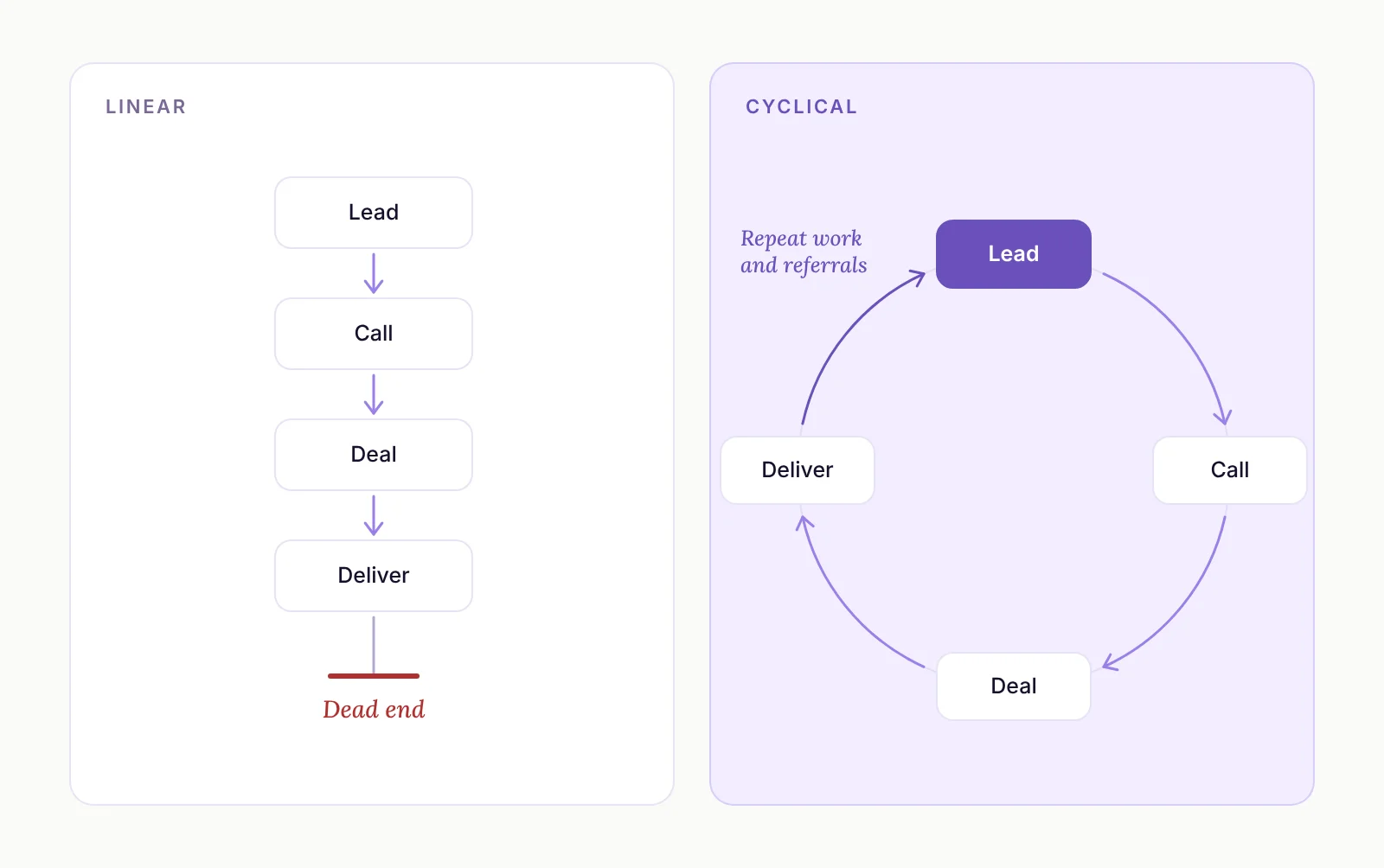
Most people run their customer journey in a straight line. A lead comes in from somewhere (a cold email, a referral, a website form, whatever). You reach out, book a call, close the deal, deliver. Then you forget about them and go find new leads.
The most expensive thing you do in your business is figuring out how to get new leads. If you want a predictable business, keeping past clients engaged and asking for referrals off the back of your work comes first.
So you make the journey a loop. After you deliver, you stay in touch for repeat work, and you also have a process for bringing new leads through the door from the clients you already have. The client isn't the end of the line. They're how the next cycle starts.
The Ideal Version Starts before the Event
In a perfect world, the referral ask happens on a debrief call, and that call is already on the calendar before you ever take the stage.
Here's how that plays out:
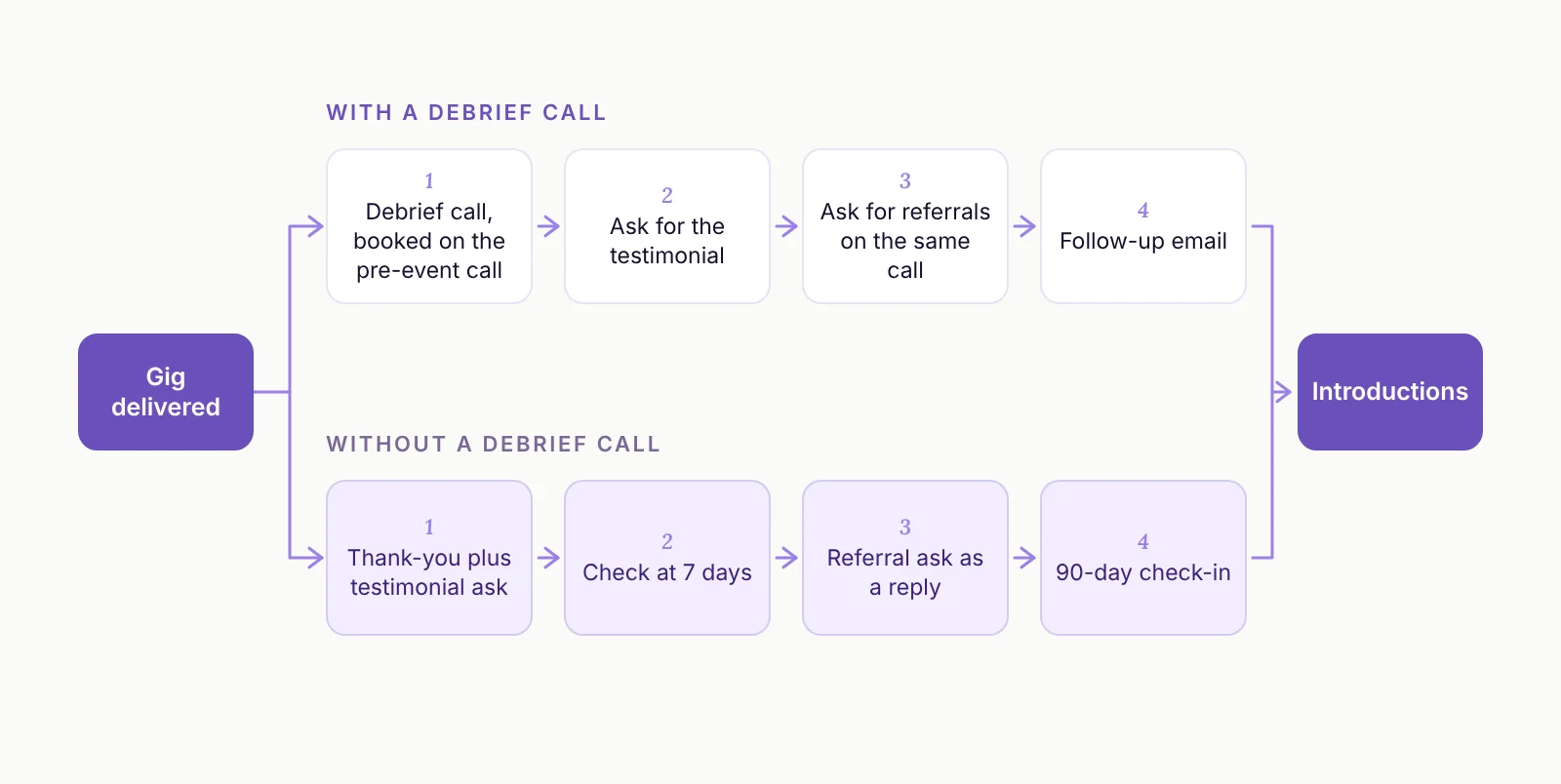
Pre-event call. You're already having one to customize your content and learn about their event. Before you hang up, schedule the debrief call. Typically one to two weeks after the event. There's no hard and fast rule, but get it booked.
Debrief call. Run it the same way every time. Toward the end, ask if they'd be open to providing a testimonial.
The referral ask, same call. They say yes, and you say, "Great, thanks so much. In addition to that, would you be open to introductions to people you might know?"
Follow-up email. Thank them for being willing to leave a testimonial, include a link to leave it, and include the email template they can use to introduce people to you directly.
Especially on a call, most people will say yes.
On the call, it sounds something like this:
I know you know this, but referrals drive pretty much everything I do. [If they came to you by referral: Even you were referred to me by [Name].] I'm curious, are there three people you know who might also benefit from the work we've done together? I have an email template to make intros super easy. Would you be open to making a few introductions?
If you don't run debrief calls, start there. Figure out why you don't have one, then put a structured one in place. A podcast guest of ours who speaks on customer service does exactly this, and he walks through how he runs his feedback call about two weeks after the speech.
No Debrief Call? Testimonial First, Then the Referral
Sometimes a debrief call just can't happen. Then you have to choose which ask goes first, and I'd go with the testimonial every time.
Here's the email version:
A day or two after the event: send a thank-you email with the testimonial ask in it. Keep it personal and pull from something that actually happened at their event.
Seven days later: a task asks, "Did we get the testimonial?" If not, follow up once or twice. It's pretty rare that you won't hear back from the decision-maker.
When the testimonial comes in: reply to that email with the referral ask. Same thread, not a new email.
If they don't answer the referral ask: follow up on it.
After that: a past-client check-in task every 90 days takes over. (I cover why that one stays personal in Automate the Trigger, Not the Touch.)
A lot of people want to cram the thank-you, the testimonial ask and the referral ask into one email. I get it. They want to rush the process. The trick is to not rush the process.
Why the Testimonial Comes First
The testimonial tells you whether the referral ask is even worth making.
If someone isn't willing to leave you a testimonial, you don't have to deal with the embarrassment of asking them for referrals. You found out the easy way.
If they do leave one, the door is open. They just wrote down a bunch of nice things about you. Your next question is basically, "Would you be willing to share those nice things with a few other people?" That's a natural next step, not a cold ask.
The Two Emails (Steal These)
Most people are willing to give you referrals. They just don't know what to say. These two emails do the work for them. Swap in your details and make the first line genuinely about their event.
Send the first one a day or two after the event.
Subject: Thank you!
Thank you so much for putting on such an awesome event. I had a great time watching the audience [something specific that happened]. I hope it was valuable for them and that they'll be able to take it and [the outcome you were there for].
One quick question for you. Are you open to providing a testimonial? I'll make it super easy on you, since I know your time is valuable. I'd really appreciate it if you left one on my LinkedIn profile here: [link]. Feel free to look at the others if you're not sure what to say.
Thanks so much!
[Your name]
Send the second one as a reply to their testimonial, in the same thread.
Thank you so much for that testimonial. I really appreciated how you described [something specific they wrote]. That's going to help me a ton.
Before we wrap this up, I was curious. Are there three people you know who could also benefit from the work we've done?
I have an email template to make intros super easy. Would you be open to making a few introductions?
[Your name]
When they say yes, send them the intro email to forward. This one isn't a fixed template. Write it fresh for each client so it fits them and the work you did together. Here's the gist:
Meet [speaker]. We just had [speaker] at our event (or: I just did coaching or consulting with them). They do [x], and the outcomes were [y].
I really think you'd benefit from hiring them too, so I wanted to make an introduction. I'll let you two take it from here.
Should You Automate the Referral Ask?
The first question I usually get after walking through this is, "Can we automate the referral request?"
You can, especially if you're not running debrief calls. But I really push back on fully automating the testimonial and referral asks. What I recommend instead is tasks plus templates. Your CRM reminds you to send the thank-you, reminds you to check for the testimonial at seven days, and reminds you to reply with the referral ask. The emails are templates, so each one takes a minute. But you're the one hitting send.
You want to be reminded to do these things, with the email ready to go. The referral ask depends on what came before it, like whether the testimonial came back and what they said in it. A reminder makes sure you look.
One experienced keynote speaker I worked with had his post-event follow-up already automated, and his first question on our call was exactly that one. We built his post-event task template live on the call instead: thank-you with the testimonial ask, a testimonial check at seven days, the referral ask as a reply to the testimonial email, then the past-client check-in every 90 days. He sent over his own thank-you email to adapt, and I wrote the referral reply.
None of this works if the tasks show up and nobody does them, which is the same reason most CRMs end up abandoned for spreadsheets.
"But Asking Feels Needy"
I really understand how you feel. Plenty of people have felt the same way. But what we've found is that most people feel proud to give introductions.
Think about the last time you recommended a place or a product to someone because you found real value in it. You almost feel like the hero, pointing someone in the right direction. Your clients feel the exact same way when they introduce you.
So just start asking and see what happens. I'm pretty sure you'll be surprised. And the only way to get comfortable with it is putting the reps in. The more you ask, the easier it gets.
The other half of this is staying in touch with the clients you already have. If you want to see what that looks like when someone commits to it, our guest on He Quit Cold Outreach and Tripled His Business plans out reconnecting with every past client.
Start with your next gig. Book the debrief, ask for the testimonial, then ask for three names.