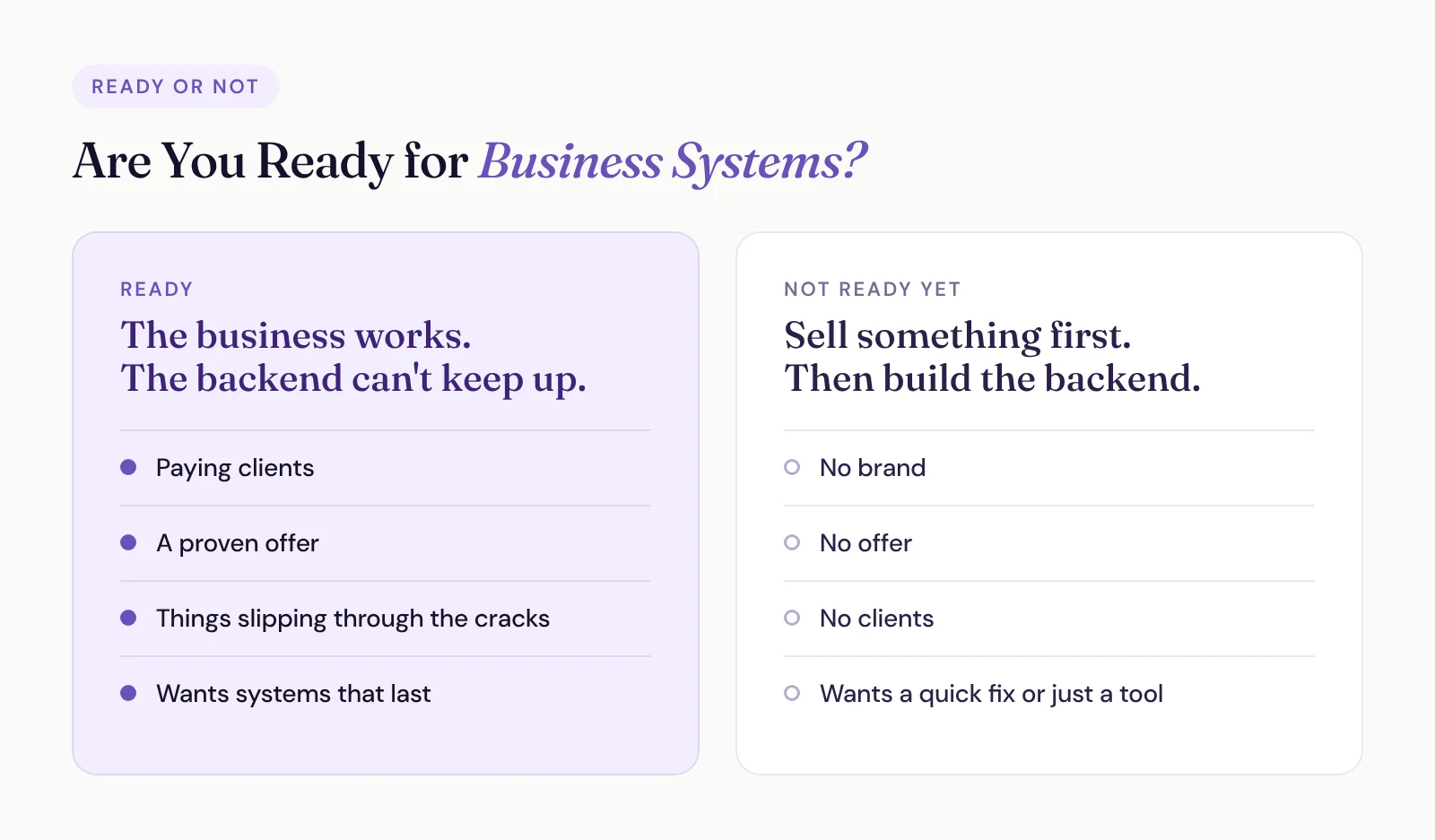
You're ready for business systems when you have paying clients and a proven offer, and your backend is holding you back. If you don't have a brand, an offer or any clients yet, you're not ready. Go sell something first.
I'll level with you - I tell people on sales calls not to buy from us all the time. Systems matter a ton. I just want you pumped to invest in your backend, with zero doubt about whether it'll pay off.
So here's how to tell which side of the line you're on.
What Does "Ready" Actually Mean?
Ready means the business works and the backend can't keep up with it.
You have an offer people pay for. You have clients. Maybe a book, some talks, a coaching program and a few consulting gigs. Revenue is coming in, but you're running it with spit and duct tape, and you're too busy to fix it yourself.
Not ready looks like early stage: no brand, no offer, no clients. It also looks like someone hoping a tool will answer the question "will anyone buy this?" Systems make a working business run better. They can't tell you whether you have one.
The other thing that makes someone not ready is wanting a quick fix. If you're shopping for one more app to bolt on, you'll end up with one more app to manage.
Six Signs You're Ready for Business Systems
If you have clients and an offer, these are the tells that the backend is the bottleneck:
Things are slipping through the cracks. A follow-up you meant to send. A past client you forgot to check in with. A referral you never thanked.
You're not sure how to spend your day. You sit down and pick whatever feels most urgent.
Your systems don't tell you what to do. You guess. Every single day.
You can't tell if you're on track. Ask yourself whether you'll hit this year's revenue goal. If the honest answer is "I think so?", that's a sign.
There's friction everywhere. Tools that don't talk to each other, the same info typed into three places, contracts built by hand.
You're doing a lot by hand, and you've had enough. This is the big one.
Every hour you spend on manual work is an hour you're not spending on promotion, sales and the things that actually bring in revenue. That's the real cost.
Why You Can't Run a Business from Your Head
A life without systems means the whole business lives in your head. Who you talked to. What you promised. When to follow up. Which event needs slides by Friday.
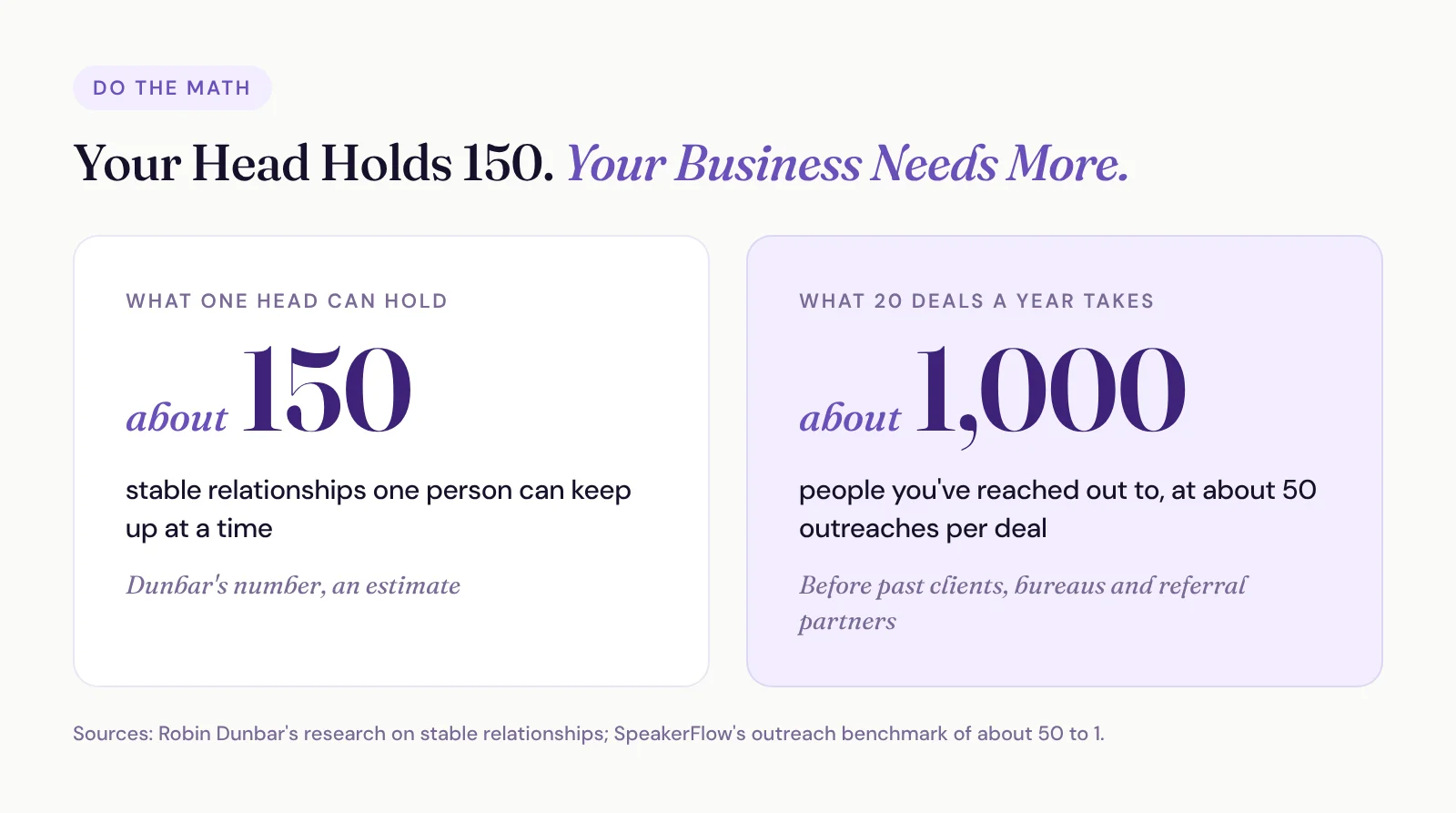
There's only so much a person can hold. Researchers put it at around 150 stable relationships at one time. That's Dunbar's number, and it's an estimate people still argue about, but the point stands.
Now do the business math. Cold outreach runs about 50 to 1, at least. Want 20 deals a year? That's about 1,000 people you've reached out to, before you count past clients, bureaus and referral partners. Even if your memory were perfect (nobody's is), there's no way to keep up with all of that by memory alone.
When everything's stuck in your head, you're stuck at the bottom of Maslow's hierarchy, just trying to keep the lights on. When your relationships live somewhere safe and your system tells you what to do next, you can get back to your zone of genius. That's the whole idea behind Flow State: time slips by and you're doing your best work.
If you feel like you're grinding all day, or you keep ignoring things you know you should be doing, that's a systems problem.
Get Ahead of the Pain or Wait for It
I joke that there are two types of people when it comes to business systems.
The first type wants to get ahead of the curve. They put systems in place before the pain gets loud. That works great, as long as you've already proven you have a business: a brand, an offer and clients.
The second type would rather drag out the pain. They feel the friction, let a few balls drop and fix it once it hurts.
There's no right or wrong here. We all have to reach the point where we've had enough of the status quo. Some people just get there sooner.
"My Business Is Too Simple for Systems"
This is the one I hear most. Someone tells me their business is pretty straightforward, and then they list it out. A book, keynotes, coaching, consulting, an online course, yada yada.
That's five businesses. Each one has its own path from first touch to paying client. Plenty of companies don't have that many offers.
And even if you only speak, or only coach, you still need the same basics:
A way to organize your leads
An email list
Workflows for before and after someone buys
Project management for delivery
Accounting
Sure, some businesses are more complex than others. But business is complex, period. Systems are how you keep your sanity while it grows. If you want to see how all those pieces connect, here's how leads turn into clients in an expert business.
"I Need to Get My Stuff Together First"
That depends on what "stuff" means.
If it means your brand, your offer and your first clients, then yes. Get those together first.
If it means your systems, then no. If you had your systems together, you wouldn't need help with them. Some of the clients who do best with us start with the fewest systems, because there aren't many bad habits to undo.
The people who try to "get it together" first usually DIY it. That's hundreds, if not thousands, of hours of setup, banging your head against the wall and wondering whether you built it right.
Think of it like a car. DIYing your systems means deciding what the car should look like, how fast it goes and what buttons go inside. Then you order every part, put it together, discover the parts don't fit, customize them until they do and finally get to drive. And when something breaks, you're the mechanic.
Or you can have a car built to your spec, get in and drive. That's what implementation actually buys you.
What Four Years of DIY Looks Like
One speaker first talked to us about four years ago, roughly six months into her speaking business. She was taking the leads that came in and doing the talks. In her words, she "just didn't know what I didn't know."
Fair enough. So she built it herself.
When she came back this year, she had "a patchwork of subscriptions and things I pay for that probably cost me just as much, but don't work nearly as well." Follow-up depended on her remembering people. She'd even wired her event prep tasks into her calendar, which worked, but it was messy.
What she wanted was simple: "I just need something where it's not my brain."
Partway through that call, she said it herself: "I feel so dumb for not doing this years ago."
She wasn't dumb. She was busy building a car while trying to drive it. That's exactly the trap.
What If You're Not Ready Yet?
If you don't have an offer, a brand or clients, there's an order of operations:
Design the offer. Speaking, coaching, consulting, whatever you sell.
Get your brand in place. The website and your presence.
Start reaching out and making money.
You don't need a full backend for any of that. A spreadsheet with Claude on top works. So does a simple Claude artifact that keeps track of who you've talked to. Use it to figure out what working looks like: what you say, how often and to whom.
Then, once clients are coming in and there's money to invest, skip the DIY years and hire pros. Otherwise you end up on what I call the migration hell loop, where every year you're moving to a new tool and rebuilding your system from scratch.
One more thing. People happily spend money on the stuff everyone sees, like the website, the sizzle reel and the new book. Those matter. The backend matters just as much, because being more on top of things than your clients are is a big part of why they trust you.
Is "Bad Timing" Really about Timing?
"The timing isn't ideal" is the most common reason people hold off. So ask yourself what it actually means.
If you're busy and your systems are a mess, now is the time. It only gets harder as you get busier.
If you're waiting for things to pick up, you'll have even less time to set anything up when they do.
If it's really a budget issue, that's a smart reason to wait. Don't take out a loan or put this on a credit card. Make the money first.
The sweet spot is money in the bank, confidence that the business is moving forward and a bit of downtime. That gives you room to learn the system and ramp back up, instead of slowing down mid-rush to speed back up.
What's the ROI on Business Systems?
The ROI is your time back.
Here's an example. Say you spend 10 hours a week on manual work, or 10 hours a week of work isn't getting done because you're stuck on the manual stuff. If your hour is worth $500, that's $5,000 a week. You're lighting it on fire.
We don't promise that systems will make you more money. Systems give you back the time to do the things that make money, and that's how the money follows.
And paying before the return is how business works. You pay for the roof before it's on. Your clients pay you before you take the stage. Systems are no different.
If you have clients, an offer and a business that lives in your head, you're ready. If you don't have those yet, go sell something. Either way, you know what to do next.