I'll give you my bias up front. We build our clients' businesses on one platform, so of course I think you should run yours on one.
I'd say it even if we didn't. Running your business from one platform takes a lot of the pain out of managing technology. It lowers your bill over time. And it gets you out of the migration hell loop, where you're moving your core systems every year or two.
You won't run 100% of it in one place. Almost nobody does. But about 80% in one place, with the other 20% connected to it, beats a dozen apps that don't talk to each other every single time.
How You Ended Up with a Dozen Apps
Nobody sits down and designs a stack with 12 apps in it. It just happens.
You need a way to book meetings, so you grab a scheduling app. You need to send invoices, so you get an accounting app. Your site lives on one platform, your files on another, your email somewhere else. That's the status quo, and you layer tools in one at a time as you grow.
The alternative feels worse. Platforms that run a whole business are intimidating. Lots of setup, lots of features, and that sinking feeling that you're paying for a monstrosity you'll never learn.
And even if you wanted to build it right, when would you? Building systems isn't how you make money. You're selling, delivering for clients and running the business. Backend work loses that fight every time, which is a big part of why your software never sticks.
It's the same reason most people never build the connections between their apps. If it's not your day job, when are you going to do it?
What It Costs When Your Apps Don't Talk
Pull up one client and try to answer a simple question. How did they get here?
Here's where their story usually lives:
The meetings they booked are in your scheduling app, and maybe your calendar.
The emails you've traded are in your inbox.
The deal is in your CRM.
The follow-up tasks are in the CRM, in a perfect world. For a lot of people, they're on a piece of paper somewhere.
The contract they signed is in your e-signature tool.
The forms they filled out are on your website.
Their whole history with you is in pieces. You have no idea what route they took to end up where they are.
Multiply that by every client and you get data that's siloed and messy, plus a workday spent logging in and out of apps to find it.
It shows up in revenue, too. In our 2026 State of the Industry report, thought leaders with a disjointed back office averaged $167K in revenue. Those with a fully integrated one averaged $453K.
When Your CRM Is the Hub
We believe the CRM should be the hub of the entire business, with every other tool feeding into it.
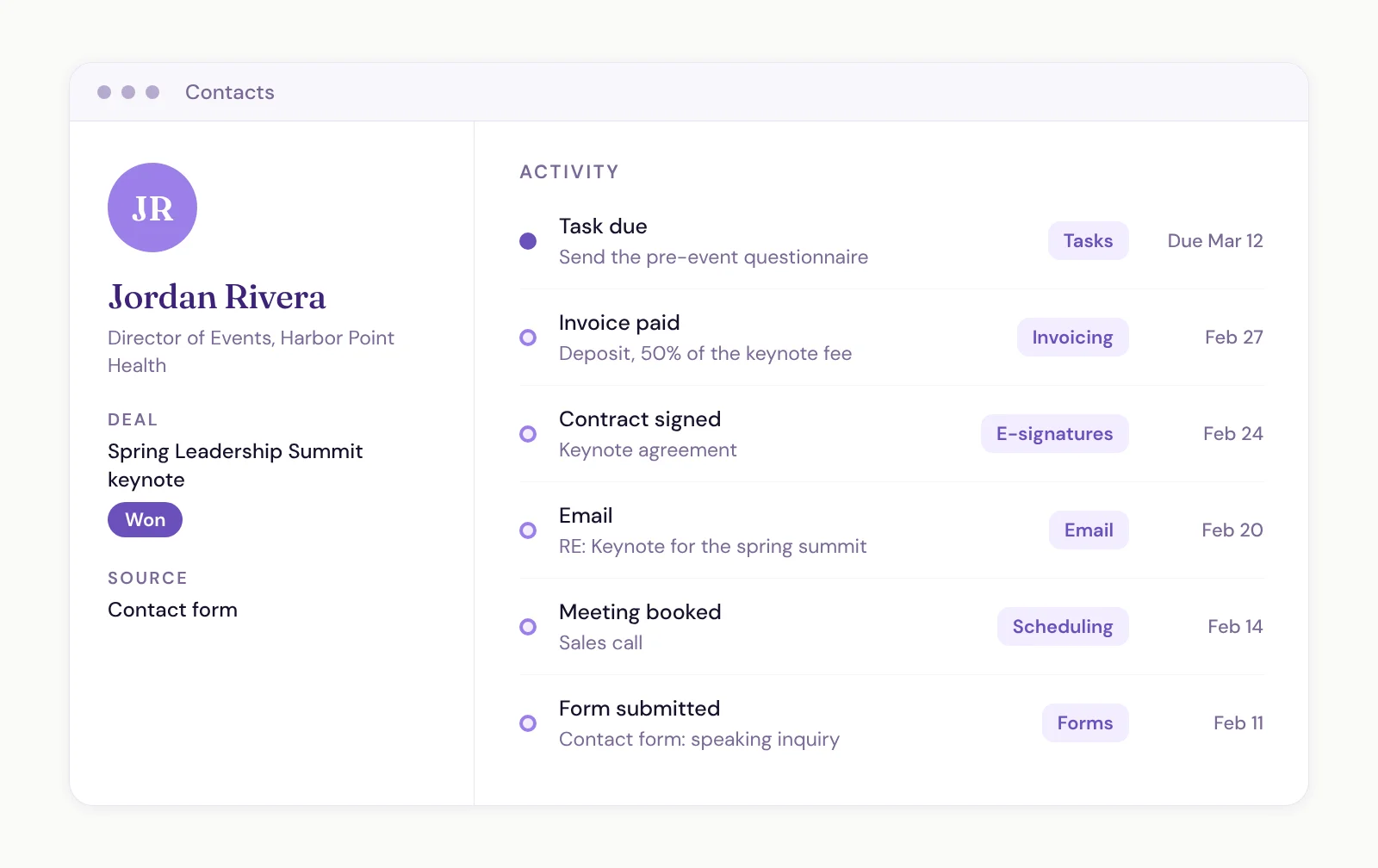
Open someone's record and their full history is right there. Every meeting booked, form submitted, email sent, contract signed, invoice paid and task due. No digging through 12 apps.
You have two ways to get there.
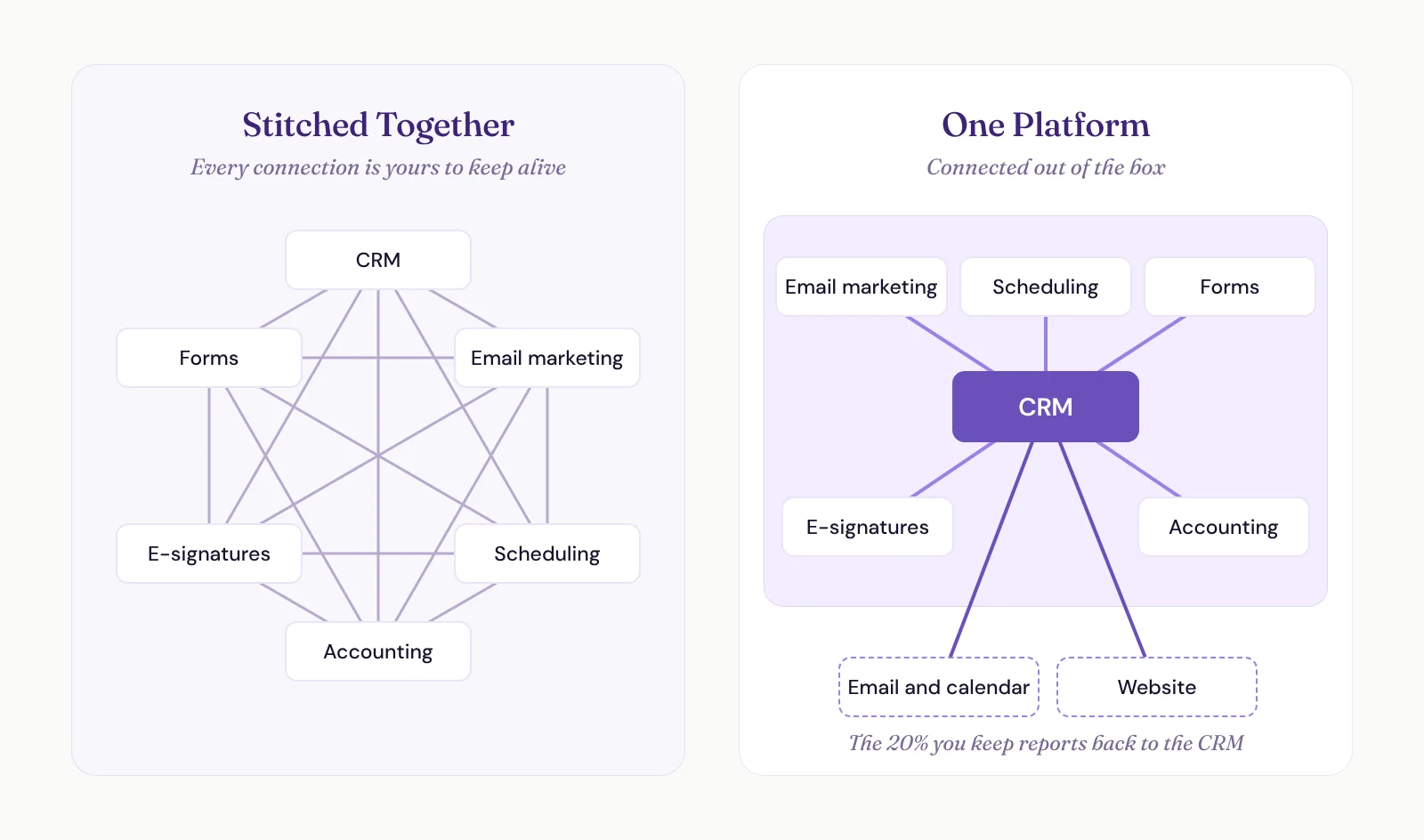
Stitch it together. Keep your separate apps and build automations between them, so every booking lands in the CRM, every form submission becomes a note and every email syncs. It can work. It's also a lot of building.
Run it on one platform. If most of your customer journey happens in one system that's connected out of the box, you spend less time setting it up and less time keeping it running. It'll also be more thorough than anything you'd design yourself.
There's a newer reason this matters. AI is only as useful as the context you can give it. When everything about a client sits in one record, AI can read it in one place instead of tapping a dozen connectors. That saves you time, and it saves the cost of all that extra back-and-forth. (More on that in connecting AI to your CRM.)
The Maintenance Math
Say you went the stitched route and did it right. Every app connected, every automation built. Congrats - that's more than most people ever do.
Now it has to keep working.
We had a client with a Zap doing a bunch of things. One of them was adding people to an automation in their email marketing tool. Later, they deleted that automation, figuring they didn't need it anymore. Nobody remembered the Zap depended on it.
So it broke. And they didn't find out until people stopped getting what they'd signed up for, and someone finally raised their hand to say, "Hey, I'm not getting this."
That's the real cost of a stitched-together stack. Every update, every change and every new freebie is a chance for something to quietly break. You're the one who has to notice and fix it, or you pay someone to, over and over.
Mostly, it costs you time. And the biggest cost is the automations people never build at all. When you're spread thin across a dozen apps, you're losing time in a dozen places, and that opportunity cost adds up fast.
Compare that to one platform where most of it's connected out of the box. You maintain the 20% you kept, instead of every connection in your business.
Aren't All-in-Ones Mediocre at Everything?
Honestly? A lot of the time, yes. That's a fair concern.
Plenty of "all-in-ones" are really marketing suites with a CRM attached. That's not enough for a thought leader's business. You need e-signatures, accounting, payroll and password storage, and maybe your website, community and courses in the same place.
When we went looking for an all-in-one seven years ago, the options were thin. We actually gave up on the search. Nothing came close.
Then Zoho, who we were already partners with, emailed us about something in beta called Zoho One.
What makes it different is how it's built. Each of its 65-plus apps is a dedicated product meant to stand alone. People around the world buy its accounting app, its CRM and its booking app on their own, instead of the big-name tools in each category. Zoho One puts all of those apps under one roof and connects them directly.
So each app is a full product with nothing half-baked tacked on, and they already talk to each other. That's exactly why we chose it. It's the only platform we've found where you could run your entire business.
It also answers the next question people ask: what happens if the system goes down? Because the apps are independent, trouble in the CRM doesn't take down your email marketing, and the other way around. You get the connection of one system with the reliability of separate apps.
The 80/20: What's Fine to Keep
None of this means you have to move everything. Some tools just aren't worth replacing.
Your email and calendar. If you're already on Google or Microsoft, there's usually no reason to move.
Your website. If it's working and you're not about to rebuild it, leave it where it is for now.
The tools you love. An industry-specific app, something with a feature nothing else has, or QuickBooks because your accountant prefers it. That's fine.
Whatever you keep has to report back to home base. It's much easier to connect the 20% into the 80% than to connect every app in your stack to every other one when there's no hub at all.
Not sure which of your tools overlap? Start with a tech stack audit.