
"If the software is $99 a month, what's the setup fee for?"
It's one of the questions I get asked most. The short answer is the one I gave a speaker who asked for a free trial a few weeks ago. "You're not paying for software. You're paying for us to build it out for you."
The software is the cheap part. Implementation is the piece missing from almost every software purchase, and it's the reason most software never sticks. Below is what that piece actually is, phase by phase, and what it costs.
Why We Won't Give You a Free Trial
We sometimes get asked for a trial, and that speaker was one of them. She'd replied to one of our emails to say she didn't have $6,000 sitting around, and the size of the setup fee worried her. In her words, "I'm concerned that the setup means that it is not user friendly." Then she asked for a 7-day trial.
Fair question. It's also backwards.
I told her the honest thing. "It's not that the software is hard to use. It's that almost nobody has the time or know-how to implement a system from scratch." And on the trial: "A week with an empty, unconfigured system wouldn't show you much of anything."
A trial would've been the biggest disservice we could do her. She'd log into a blank system with no data in it, nothing connected to her website or her email, and no automations running. Then she'd decide the software was the problem.
That request comes from thinking we're a software company. We're not. SpeakerFlow exists because we figured out early on that software fails people when they have to do all the setup and customization themselves. If you've ever paid for a CRM and drifted right back to your spreadsheets, that's an implementation problem, and it's the most common one I see.
The trial email isn't even the biggest misread, honestly. Most people just don't want to learn it themselves. They know they don't have the time, the skill set or the interest to master the software well enough to set it up. Some people are more techie and want to sort it out on their own, and that's fine. The people we've served over the last eight years figured out it's not the best use of their time.
The Software Is the Cheap Part
Tools do tool things. They're all commoditized.
A CRM stores contacts and tracks deals. An email platform sends email. Accounting software sends invoices. Pick almost any brand and those jobs get done.
I'll level with you - no one needs a CRM for speakers. Having one that's already pre-customized to how speakers work is nice. It lets us launch clients faster. The world doesn't need more software, though. It needs implementers who set it up on behalf of other people so they get the most out of it.
Software companies won't tell you that. They market their products as simple and easy to use. All of them. So when the setup never happens and the tool collects dust, it turns into blame (the software stinks) or shame (I'm bad with tech). Usually neither is true. Nobody built the thing.
Think of It as Hiring a Web Designer
Most people have hired someone to build a website, so this one clicks fast.
When you hire a designer or a development firm, you pay a fee for the build. It ranges a lot, from something like $5,000 all the way to $50,000-plus. For that, they learn your messaging and your copy, use all your assets, deal with all the fiddly stuff it takes to get a site live, and hand you something beautiful.
You still pay for the software underneath it. WordPress, Squarespace, Wix, your hosting provider, whatever it is. That's a separate, smaller bill, and nobody expects the designer's fee to cover it.
Nobody thinks a designer's fee means Squarespace is hard to use, either. Squarespace is easy. Building a site that actually does what your business needs is the hard part, so you pay someone who does it every day.
Implementation is the exact same thing. You're paying for a service where experts build the entire back end of your business for you. The software just happens to be what it runs on.
What the Implementation Fee Actually Buys
We run implementation in three phases over 90 to 120 days: Consolidate, Automate and Flow State.
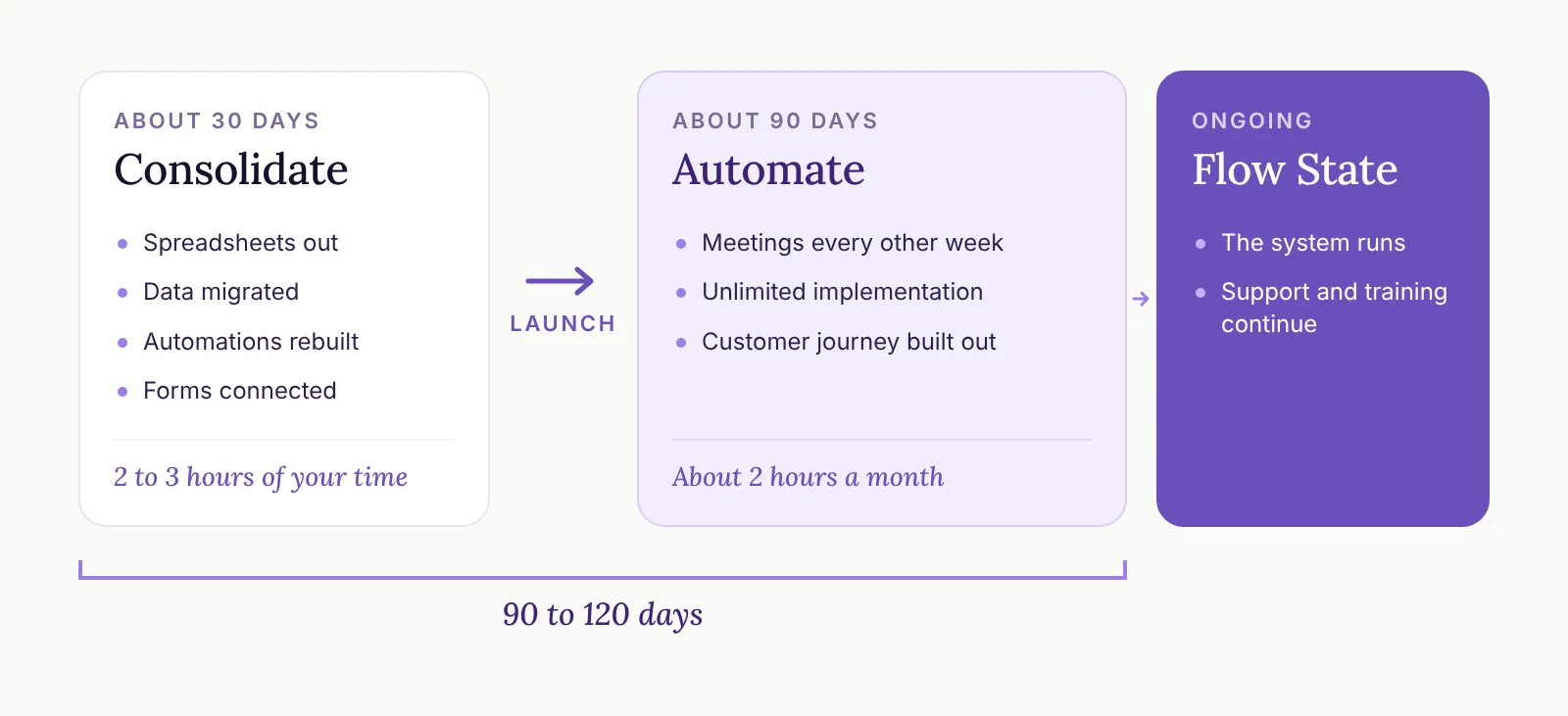
Consolidate (roughly the first 30 days). We get everything under one roof. That means getting rid of spreadsheets and the extra tools you don't need, handling migrations from your old systems, rebuilding the automations you already rely on, integrating your website forms and connecting dots that were never connected before. Your part is small. In an email to a prospect who asked how much she'd need to learn, I put it at "2-3 hours tops" for the first 30 days.
Automate (about 90 days). Once you're in the system, you launch. Then we meet roughly every other week. We hold your hand with training and Q&A, and implementation is unlimited during this phase. If something else needs building, we build it. We look at your customer journey front to back, find the holes and patch them. That covers the workflows and automations you know you should have but don't, and the ones for tasks that eat too much of your time. Plan on about 2 hours a month of your time here.
Flow State. This is the outcome. You're doing the work you love, your business has a system running behind the scenes, and you're spending your time on the bigger levers in your business instead of the admin minutiae. Support and training keep going, and anything new we build later gets quoted as its own project or a retainer.
So the fee covers more than the work to get you into the system. It's also the advisory, consulting and training that carry you through the Automate phase. By the end, you walk away with a system built around your business, the way you work and the way you think.
And the software that runs all of it just happens to be $99 a month.
One thing implementation can't do is drive the car for you. You still put the data in, send the contracts and follow up. I said on our podcast episode about keeping CRMs simple that 90% of the effort is behavioral, and that hasn't changed. A good build makes the right habits easy. It doesn't make them optional.
What Does Implementation Cost?
Pricing changes, so take these as of fall 2026.
Our most common implementation tier is $6,000-plus. The software is $99 a month, or $990 for the year. That gets you the whole suite, 65-plus apps, with everything included. We've done about 2,000 implementations.
The next question is usually "what else will I pay?" My answer to a prospect who asked exactly that was "Nothing that's mandatory." If you want something new built after implementation, we quote it as its own project, or you can go on a retainer.
Put that next to what a single keynote is worth to you. If the system keeps one lead from slipping through the cracks, the fee is a drop in the bucket.
Can't I Just Buy the Software and Learn It Myself?
You can't buy the software from us on its own. We don't offer a tier for it. We used to, and it went terribly, because there was no implementation with it. It was just like buying software anywhere else. (Austin and I talk through that lesson on the episode about where SpeakerFlow came from.)
You could go straight to the software company and build it all yourself. If you've got 500 to 1,000 hours to burn on setup, go for it. Quite honestly, though, if you have that much free time, it tells me you're not making much money yet. Go make a little, then pay experts a fee that's less than one keynote to set it up for you.
Anybody can learn anything. The real questions are whether it's worth your time, and whether you have enough interest to push through the valley of despair on the learning curve and come out the other side. Then you still have to change your behavior from the old way to the new one.
The world has plenty of software. What it's short on is someone to set it up. That's the piece you're paying for.