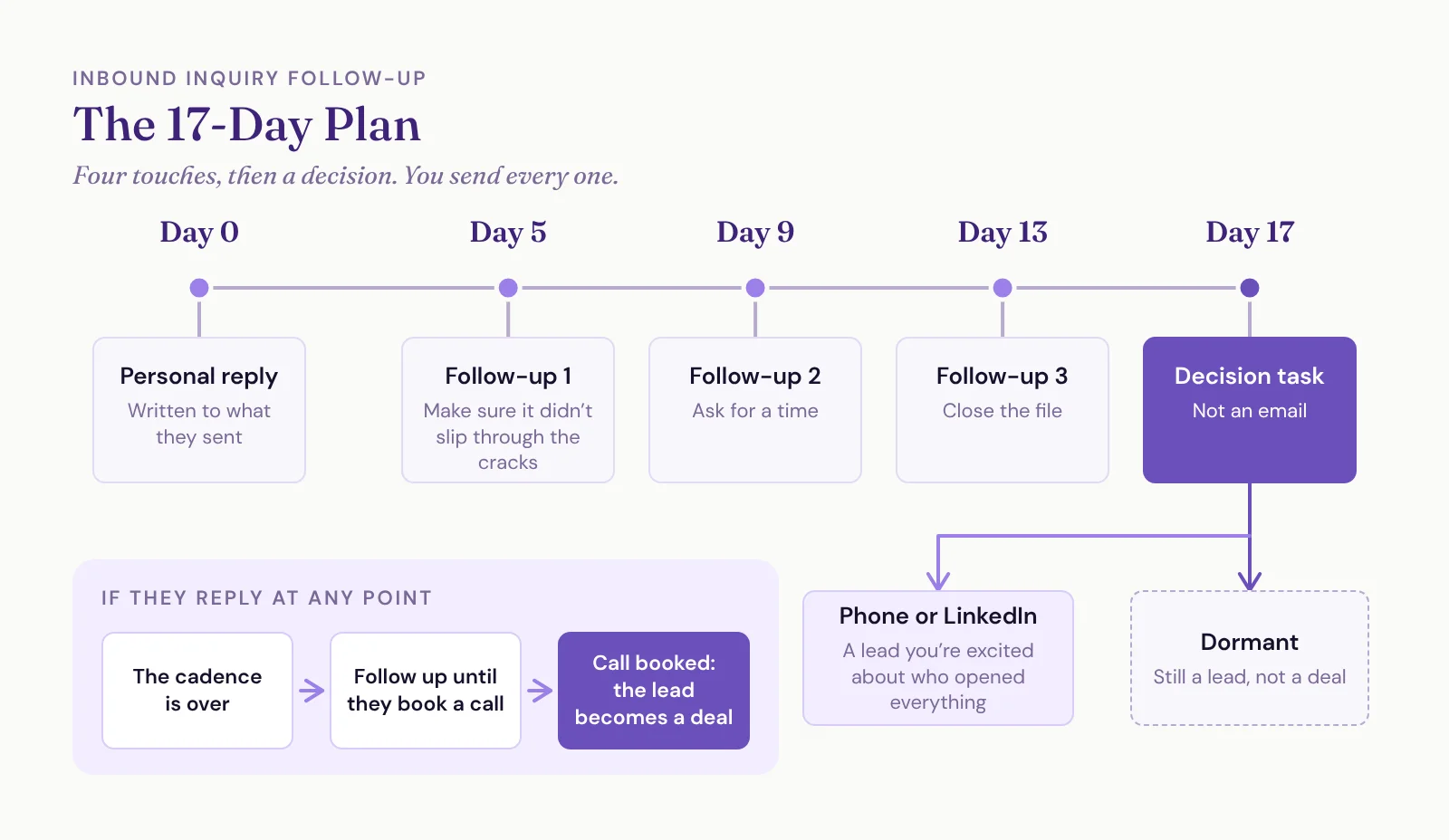
Four times. One personal reply, then three short follow-ups over about two weeks. On day 17, you decide whether this person is worth trying on another channel. If not, they go to Dormant and you move on.
This is about inbound inquiries: someone filled out your contact form, emailed you directly, sent you a LinkedIn DM or came in as a direct referral. They came to you. Everything after a call gets booked is a different game with a different number, and I covered what happens after the first call separately.
Why Most Inquiries Get One Email and Then Nothing
Most speakers have no process.
One speaker told us his follow-up was "kind of random." Then he said, "Sometimes I send a third, sometimes I don't. I probably should be every time."
That's what happens when the process lives in your head. Every time a new lead comes in, you figure out what to do from scratch. A slow week, they get three emails. A busy week, they get one and a shrug.
The fix is boring. Every new inquiry goes into the same cadence, and the cadence tells you what to send and when. Now every single lead gets followed up, whether it's a good week or not.
It only works if you actually work the tasks it hands you, which comes down to the daily habit of clearing your tasks.
The 17-Day Plan, Day by Day
Every touch goes out on whatever channel they came in on. If they emailed, you email. If they sent a LinkedIn DM, you reply there.
Day 0: your personal reply. Acknowledge what they sent you, written to whatever they put in the form or message.
Day 5: follow-up 1. Make sure your first email didn't slip through the cracks.
Day 9: follow-up 2. Bring up what they said they wanted to talk about, and ask for a time to chat.
Day 13: follow-up 3. Tell them now might not be a good time, and that you're closing the file.
Day 17: a decision task. Not an email. You decide whether this person is worth anything else.
Why five days before the first follow-up? Five days is a business week, and that's plenty of time for an inbound lead to get back to you. After that, the gaps get a little shorter.
I'll level with you, though - the exact days are kind of arbitrary. People get really hung up on timing, and it's not what makes the biggest difference. As long as you're within a week between follow-ups, you're typically fine. Doing it every time matters a lot more than doing it on day 5 instead of day 4.
The moment they reply, the cadence is over. You're in a conversation now, and you follow up until they book a call. If your follow-ups run as a cadence in your CRM, set it to stop on any reply, a booked call or a status change. Otherwise a reply to your personal email won't stop it on its own, and someone who already answered you gets a "just making sure this didn't slip through the cracks."
What to Say in Each Email
Short. Every one of these should be three or four sentences, under 100 words, quick to read.
Your first reply especially. It shouldn't have your speaker kit, your sizzle reel, your whole backstory, blah, blah, blah. If there are paragraphs in the email, you're doing it wrong. Acknowledge what they sent, say you'd love to chat, offer some times and ask what works for them. Those are the emails that get replies.
Here's what that looks like. Swap in your own words and whatever they told you.
Thanks for reaching out about [their event]. I'd love to chat about it. Here are a few times that work for me: [times]. What works for you?
Just wanted to make sure this didn't slip through the cracks. Let me know what your thoughts are on [what you sent in your first email].
You mentioned wanting to talk about [what they put in the form]. Do you want to set up a time to chat?
It seems like now might not be a good time to have this conversation. If that changes, don't hesitate to let me know. For now, I'm going to close this file out.
If they really want to work with you, they'll come back around.
Don't rewrite these from scratch every time. Keep them as templates and change the one line that's about them.
Should the First Reply Be Automatic?
For most speakers, no. If you're not doing north of about three quarters of a million dollars a year, handle every inbound lead personally. That goes for the follow-ups too.
These are people who went out of their way to fill out your form or DM you. We're talking four or five follow-ups per lead. It's not the end of the world.
Fully automatic makes sense once you have so many leads that you can't personally reply to them all, and plenty of business to say no to. Most speakers aren't there yet, and that's fine.
Post-talk leads are the other exception. When a room full of attendees tick "hire me" on your feedback form at once, that batch gets an automated sequence. I cover it, and why relevance beats a fully custom email, in Why Nobody Replies When Attendees Say "Hire Me" (and the Four-Email Fix).
Personal doesn't mean you have to remember it all, though. That's the idea behind automating the trigger, not the touch: the system creates the task on the right day, and you send the email. Make the cadence's first step a task to send your personal reply. Mark it done, and the follow-up tasks line up behind it.
What Happens on Day 17?
You decide. That's the whole task.
If the lead came from a company you'd be really excited to work with and they opened every email, maybe it's worth picking up the phone or connecting on LinkedIn. Maybe it's not. You're the only one who can make that call.
Otherwise, move them to Dormant and stop following up by hand.
Notice that's Dormant, not Lost. Someone who never answered your inquiry reply is still a lead. You never had a conversation, so there was never money on the table. Lost is for deals: you talked, there was real money on the line, and they went quiet after that.
If they've opted in to your newsletter, that's how you stay top of mind from here.
And if they reply on day 20? Great. They're not Dormant anymore. Follow up until they book a call, with a task every week until they do. Once that call is booked, the lead becomes a deal.
You might have seen me say five or six touches before you give up on a deal. That's because a deal has more on the table. For an inbound inquiry, four is typically enough, and it's about the upper limit of what most people will tolerate from sales outreach.
Won't Four Emails Look Desperate?
No. Wait until somebody actually tells you that you look desperate, and then deal with it.
So many people get hung up on how they're perceived. We're all trying to run a business here, and there's nothing wrong with that. Besides, they're the ones who reached out to you. Nobody fills out a contact form hoping you'll never write back.
Same goes for "bureau agents hate follow-up." They hate transactional follow-up. We have a client who emails a list of a few hundred bureau agents every week with new research and how it helps their clients, and they eat it up.
Send the four. The worst case is a quiet inbox, which is exactly where you'd be if you hadn't.