You gave a great talk. A handful of people told you on your feedback form that they want to hire you. You followed up. Crickets.
I hear this on calls all the time, and the cause is almost always the same. The emails are too long, they aren't direct about what you want, and they go out too late.
Good news - the fix is less work than what you're doing now.
Why Don't People Who Say "Hire Me" Reply?
Start with the math. How many people raise their hand depends on who's in the room. Speak to a room full of staff members and most of them don't have buying power. Speak to an association full of leaders and you should expect somewhere around 3 to 7 percent of the audience to say they want to hire or refer you.
That's a high-volume game. Some of those people are ready to talk. Plenty of them aren't yet, and that's normal.
We had a speaker client living this. He was getting about seven "hire me" checkboxes per 100 leads. His team sent each one a custom email from a template in his inbox.
Zero response.
Worse, it took about a week to get anything out at all, because the personalization needed a pile of custom fields filled in first. He felt like every hand-raise deserved a personal follow-up, so he kept doing it. In his words, "it's almost like I need permission to stop doing that."
Consider this your permission.
Personalization Is Slowing You Down
Every speaker I talk to reaches for the same fix: make it more personal. Thanks for coming to my 45-minute session on this topic, at this event, on Thursday.
It doesn't matter. High volume and high manual doesn't math.
When was the last time you bought something because somebody knew something weird or specific about you? You don't. You buy what you need, when the timing's right, when it's relevant and when you have the budget.
I've spent ten years selling and generated millions of dollars doing it, and personalization does very little, especially for inbound leads. If these were cold leads who'd never heard of you, maybe you could argue some personalization helps. These people just watched you on stage.
Personalization also has a real cost, and it's speed. If the email pulls in the event name and the session details, somebody has to check it by hand before it goes out, because a wrong event name looks really bad. That review is where the delay comes from. One day becomes three. Three becomes a week.
That's the wrong trade-off. People need to hear back about their request right away. The next morning at the latest.
For your most important relationships, you automate the trigger, not the touch. A stack of form leads after a talk is the opposite case: lots of people asking for the same thing, where speed matters more than a custom line.
Lever One: Ask One Clear Question on the Form
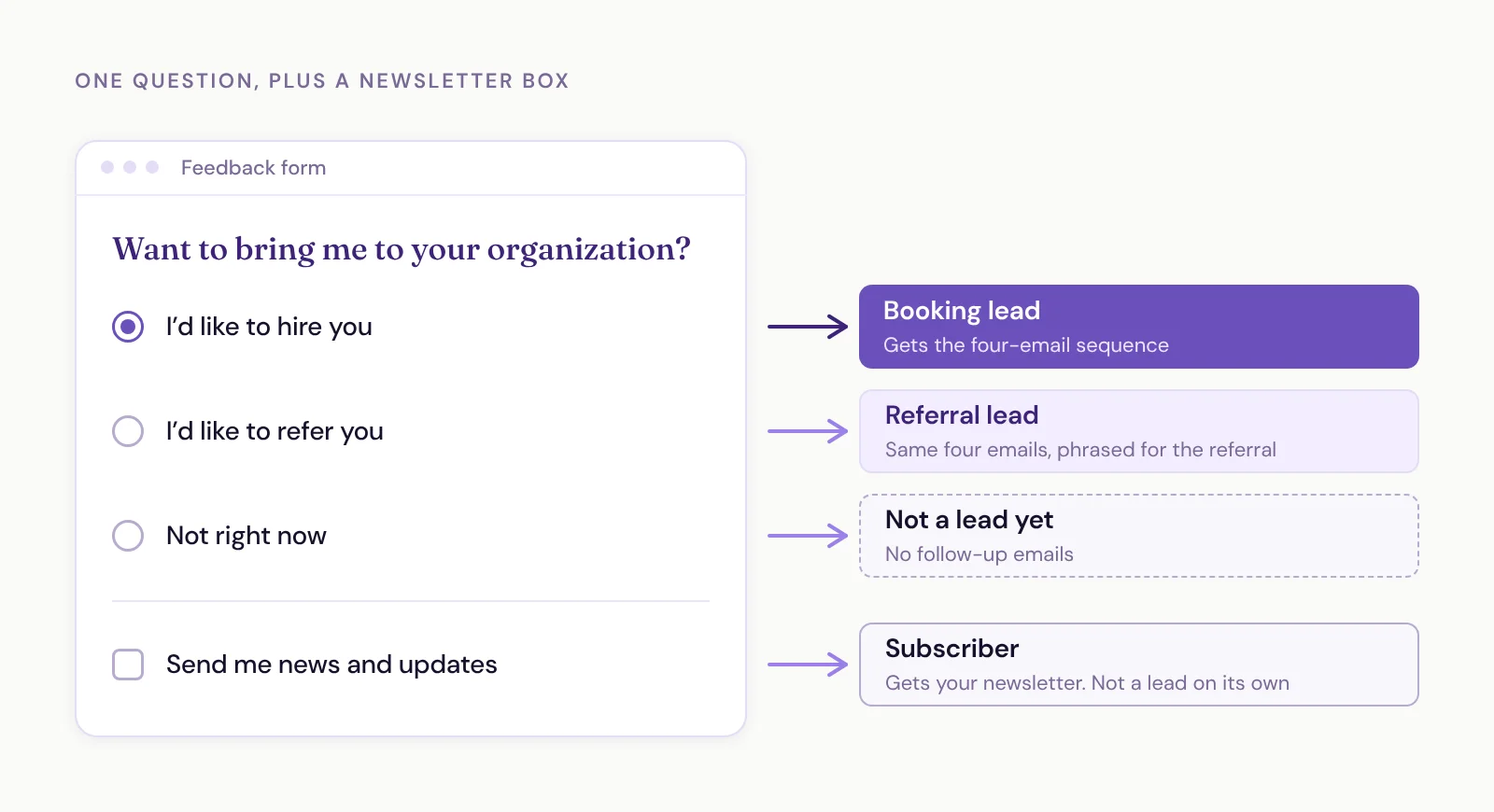
Before you fix the emails, fix who gets them. Checkboxes let people tick everything to be nice. Ask one question that takes one answer instead:
Want to bring me to your organization?
I'd like to hire you
I'd like to refer you
Not right now
Then give the newsletter its own checkbox underneath it: Send me news and updates.
That splits your responses into booking leads and referral leads, and anyone can tick the newsletter box on top of either answer. "Not right now" gets no follow-up emails. Someone who only ticks the newsletter box is a subscriber, not a lead, so they don't get these emails either. If you have another offer, like coaching, it can be its own option with its own emails.
Keep the referral option on every form. Plenty of people in your audience can't hire you but know someone who can, which is the whole idea behind the cyclical customer journey. Referral leads get the same four emails below, phrased for the referral.
The rest of the form, question by question, is in What a Post-Talk Feedback Form Should Ask (and Whether You Still Need a Paid Tool).
Lever Two: Make Sure Your Emails Actually Land
Deliverability is very real. If your follow-up lands in spam, nothing else in this post matters.
Your domain needs these records:
SPF and DKIM for your email service provider. The vast majority of people don't have them.
SPF and DKIM for every other tool that sends email on your behalf, including your CRM.
A single DMARC record. Just one for the whole domain.
To check yours, send a test email to mail-tester.com. It scores the email and shows you what's missing.
Who the email comes from matters too. These go out from your CRM in plain text, from your own address, so they look like you typed them in your inbox. Not from your assistant's address, and not as a designed newsletter. They said they wanted to talk to you, so it should come from you.
Lever Three: Keep the First Email Short
Picture someone walking up to you after your talk and saying, "I want to hire you for an event." You wouldn't launch into a long story about your background and how much you loved their conference. That would be weird.
You'd pull out your phone and say, "Great, let's set up a time to chat."
Your first email should do the same thing. Cut the heavy personalization. Cut the stories. What's left is a thank-you, a line saying you saw they want to chat, a question about when and your calendar link.
The Four-Email Sequence, Word for Word
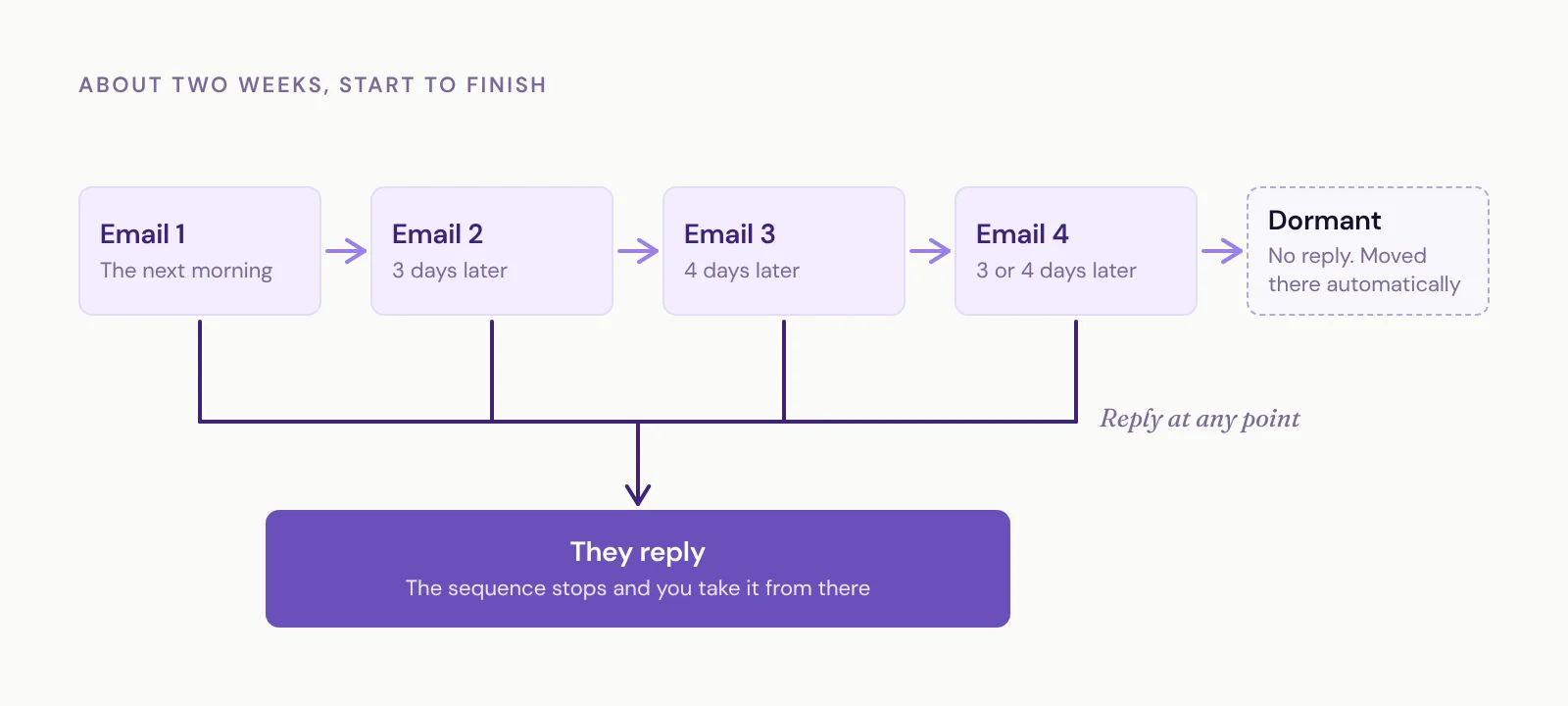
Here's the sequence I'd set up. Each one is plain text and goes out automatically. The moment someone replies, the sequence stops and you take it from there.
The first three emails ask them to grab a time that works. Link those words to your booking calendar, so saying yes takes one click.
Subject: You wanted to chat?
Thanks so much for attending my session - I appreciate you giving feedback!
It looks like you wanted to chat about working together.
When's a good time to do that?
Feel free to [grab a time that works] and if you're not seeing anything that lines up, let me know!
[Your signature]
Subject: RE: You wanted to chat?
We haven't gotten that call on the books yet, and my calendar tends to fill up pretty quick.
Do you want to chat about your upcoming event?
Feel free to [grab a time that works] and if you're not seeing anything that lines up, let me know!
[Your signature]
Subject: RE: You wanted to chat?
Is this not the right time to talk about your event?
You mentioned you wanted to chat after my session a week or so ago.
Feel free to [grab a time that works] and if you're not seeing anything that lines up, let me know!
[Your signature]
Subject: RE: You wanted to chat?
It seems like now must not be a good time to connect. No worries!
If that changes, don't hesitate to reach out.
In the meantime, I hope you enjoy my content and get value from it.
Talk soon.
[Your signature]
That's about two weeks, start to finish. After email four, the lead moves to Dormant on its own. Nobody has to remember to do it.
How Do You Break Up without Being Rude?
Some people get nervous about email four. Isn't it rude to tell someone you're giving up?
Only if you make it about them. "You're not getting back to me, so I'm going to stop" is an accusation. "It seems like now must not be a good time" describes what you see. Phrases like "it seems like" and "it sounds like" take the pressure off.
That's all a breakup email needs to be. Short and kind.
What Happens after Email Four?
That depends on how bad you want the business.
Four emails should generate enough interest from anyone who's ready. If you want to go further, the best version is a task that fires when the sequence ends and tells you to review their engagement. If they opened every email and clicked everything, send a LinkedIn connection request. Then maybe pick up the phone.
Plenty of people say they don't have time for that, and that's fair. It depends on how much inbound you have. More touches across more channels is better, as long as you have the time and the willingness.
When someone does reply, the real sales process starts. Here's what to do after that first conversation so the deal doesn't stall there.