Why Doesn't Anyone in My Audience Book Me?
Because most of the people in your audience can't. And capturing them is still 100% worth it.
I hear some version of this question on almost every call. One speaker put it perfectly: the people who book him and the people sitting in his audience are two completely different groups. He'd walk off stage with several hundred new contacts and wonder if any of them were worth keeping.
If that's you, you're not alone. This is literally everyone I talk to.
There's one catch. Capturing attendees only pays off if you have a plan for staying in touch after you walk off the stage. Most speakers don't have one yet.
Your Business Has Two Audiences
Every thought leader has two audiences.
The first is your economic decision makers. These are the people who can actually hire you: the meeting planner, the executive director or whoever owns the budget.
The second is your content consumers. They want your ideas and your stories. They're your followers and audience members, and they're usually the people your talk is for.
Those two groups rarely overlap. A leadership speaker hired by a corporation gets booked by an executive, but the people in the seats are employees.
How many decision makers end up in the room depends heavily on who you're speaking to. Speak to the staff of a company, and there'll be vastly fewer economic decision makers than if you're speaking to an association of leaders.
Most speakers have offers for both groups, too. Your B2B offers are speaking, high-level consulting, executive coaching and whatnot. Your B2C offers are your books and your courses. Content consumers are your B2C audience. They might never book a keynote, but they could absolutely buy the book.
So Is Capturing Their Info Worth It?
Yes, and the math is why.
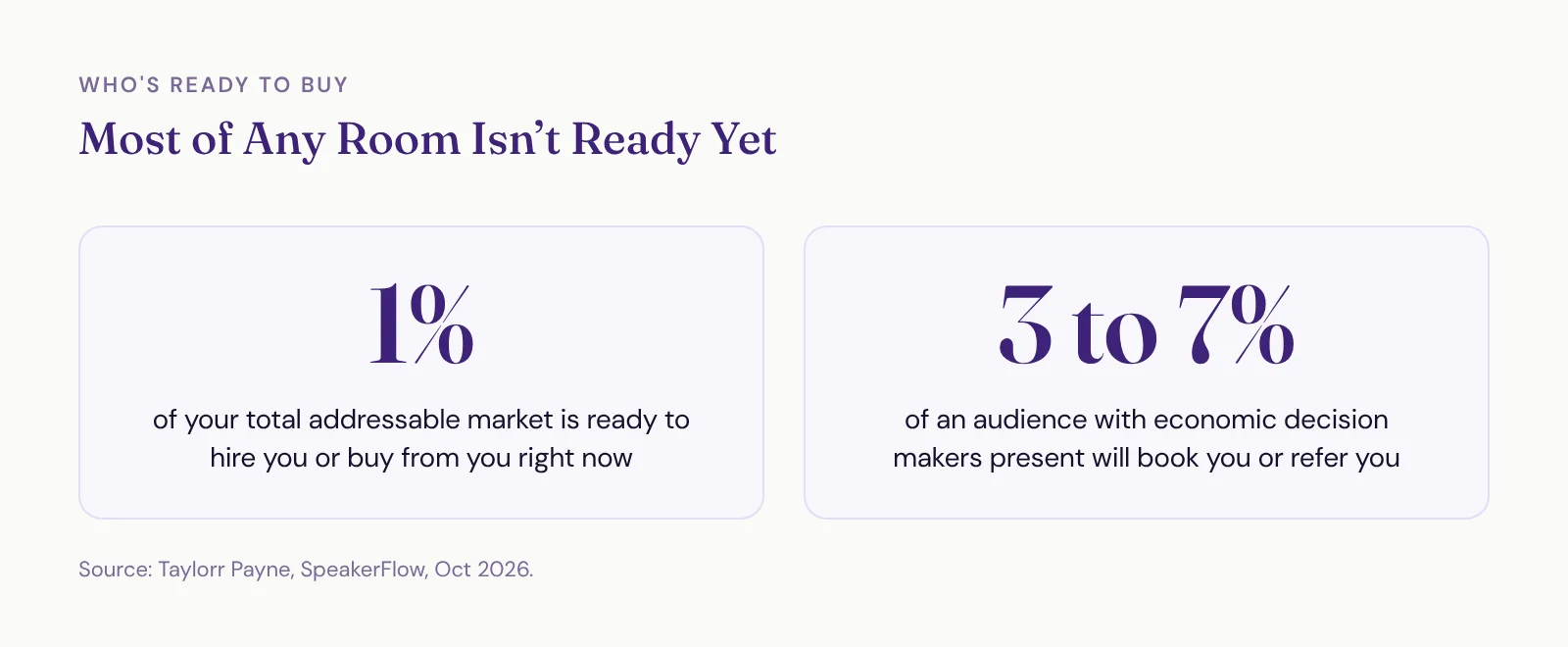
Only about 1% of your total addressable market is ready to hire you or buy from you right now. That's true of pretty much any business, not just speaking. Part of the job of marketing is finding that 1% at any given time.
The other 99% sit in one of two places. Some don't know they have the problem yet, so they need educating that they do. Others know they have the problem, but they're evaluating, figuring out budget and waiting for the timing to make sense.
Capture them and nurture them over time, and more of them move into that 1% as their timing and budget constraints ease up.
In an audience where economic decision makers are present, we generally find somewhere between 3 and 7% of the room will book you or refer you. In a room full of staff, that number can be zero. That's the audience makeup. Your talk is probably fine.
So what about everyone else? They're still worth keeping:
They refer you. If you stay on top of your email marketing, they'll talk about you, refer you and share your newsletter.
They get promoted. The person in row 12 today could be running the department in a couple of years.
They remember you. When their company needs a speaker down the road, you want to be the name that comes to mind.
They buy your other stuff. Your books and courses are built for exactly these people.
Attendee referrals are a separate stream from asking the client who booked you for referrals. Do both.
What Most Speakers Get Wrong
The big mistake is thinking the people in your audience who aren't economic decision makers aren't worth keeping.
The second mistake usually comes with it. There's no structured email marketing strategy, so nobody stays top of mind with the people coming in. The contacts just sit in a database going stale.
That's the catch I mentioned. A list you never email is a spreadsheet with extra steps.
Where Each Attendee Should Go
I cover the form's questions in What a Post-Talk Feedback Form Should Ask. Here's where each answer goes once someone hits submit:
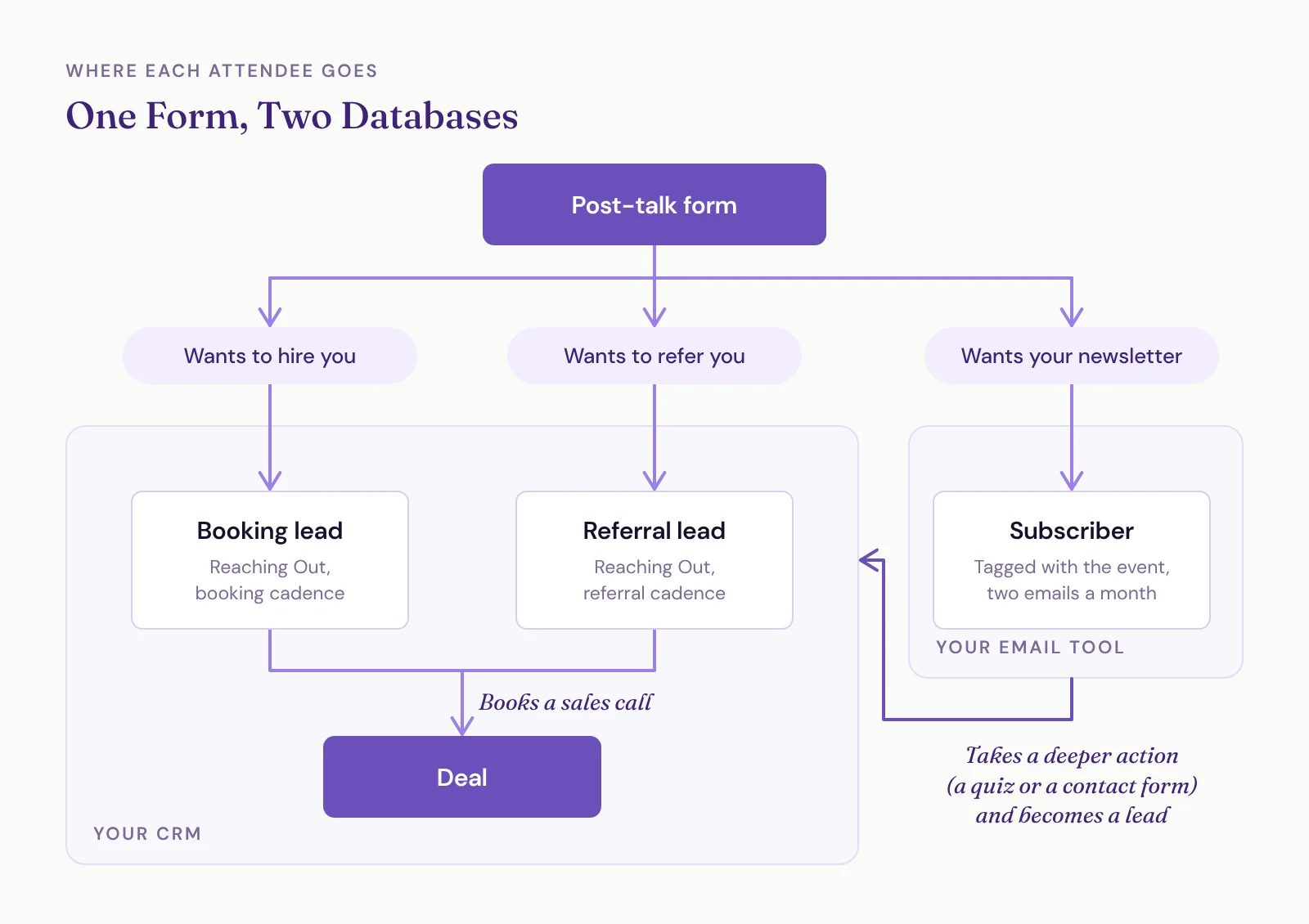
Booking leads go to your CRM. Someone who wants to talk about hiring you becomes a lead, gets a lead status of Reaching Out automatically and is enrolled in a booking cadence.
Referral leads go to your CRM too. Same idea, separate cadence, because the phrasing is different. "You wanted to talk about hiring me for an event, let's do that" is a different email from "You wanted to refer me, let's do that."
No reply after the last email moves them to Dormant. They stay in your CRM, out of your active follow-up.
Newsletter opt-ins go to your email tool, not your CRM. Tag each one with the event they came from.
What those cadences actually say is in Why Nobody Replies When Attendees Say "Hire Me" (and the Four-Email Fix).
Your CRM and your email marketing tool should be two different databases. Some people will end up in both, and that's fine. What you don't want is a CRM full of people who can't hire you. I go deeper on why in Why Newsletter Subscribers Don't Belong in Your CRM.
Everyone who opts in starts as a subscriber. When a subscriber takes a deeper action, like a quiz that shows they have decision-making power or a contact form, they become a lead in your CRM. A hire or refer answer on your form does the same thing. Once a lead books a sales call with you, they become a deal, and from there a client.
What to Send the People Who Can't Hire You Yet
Staying top of mind doesn't take much. Here's the standard I recommend: two emails a month, a welcome series and a re-engagement campaign.
A resources email. Pick a problem your audience has and share resources on solving it. Your own podcast episodes and blog posts count, and so does curated content other people made.
A behind-the-scenes email. Share a story, a lesson or a takeaway. Something like, "Last week I spoke in front of a few thousand professionals, and something happened on stage that stuck with me." End with a question to get a reply.
A welcome series. Five to eight emails over a couple of weeks that explain what you do, give value and make an ask.
A re-engagement campaign. Anyone who hasn't opened an email in six months automatically gets three or four emails that try to win them back. If they don't re-engage, they're unsubscribed automatically to keep the list clean.
Don't skip the behind-the-scenes email. You're talking about the work you do without pitching it, and you're reminding people you're a human being. That's how they get to know you.
But I Don't Want to Be an Email Marketer
This is the pushback I hear most. People hear "newsletter" and picture the spam they get from someone they met once.
That's not what I'm describing. Resources and behind-the-scenes emails are value-added content and stories that help people get to know you.
I'll level with you - if you skip this, you're objectively leaving money on the table. Why do you think so many people use email marketing? Because it works.
Flip it around. You're sitting down with a decision maker about hiring you for an event, and they say they'd love for their attendees to keep hearing from you. You say, "No, I don't do a newsletter." That person just lost a lot of trust in your ability to keep nurturing and educating their people.
A good nurturing process for your mailing list is a value-add you can bring up in sales conversations.
I really believe in the work we do at SpeakerFlow. I'm so convinced of its value that if we didn't share more resources on how to do what we do, we'd be doing our people a disservice. Why wouldn't you want to keep educating yours?
When Capturing Attendees Isn't Worth It
When the event tells you not to. Respect that.
The easy way to find out is to ask. On your pre-event call (or your debrief call, if that's part of your process), ask something like, "Hey, are you okay if I put a form up for feedback? They'll be able to join my newsletter if they want." You'll get a yes or a no on the spot. If it's a no, don't put it up.
Otherwise, capture every attendee you can. You never know what can come of those relationships.