What Should a Speaker's Email Marketing Look Like?
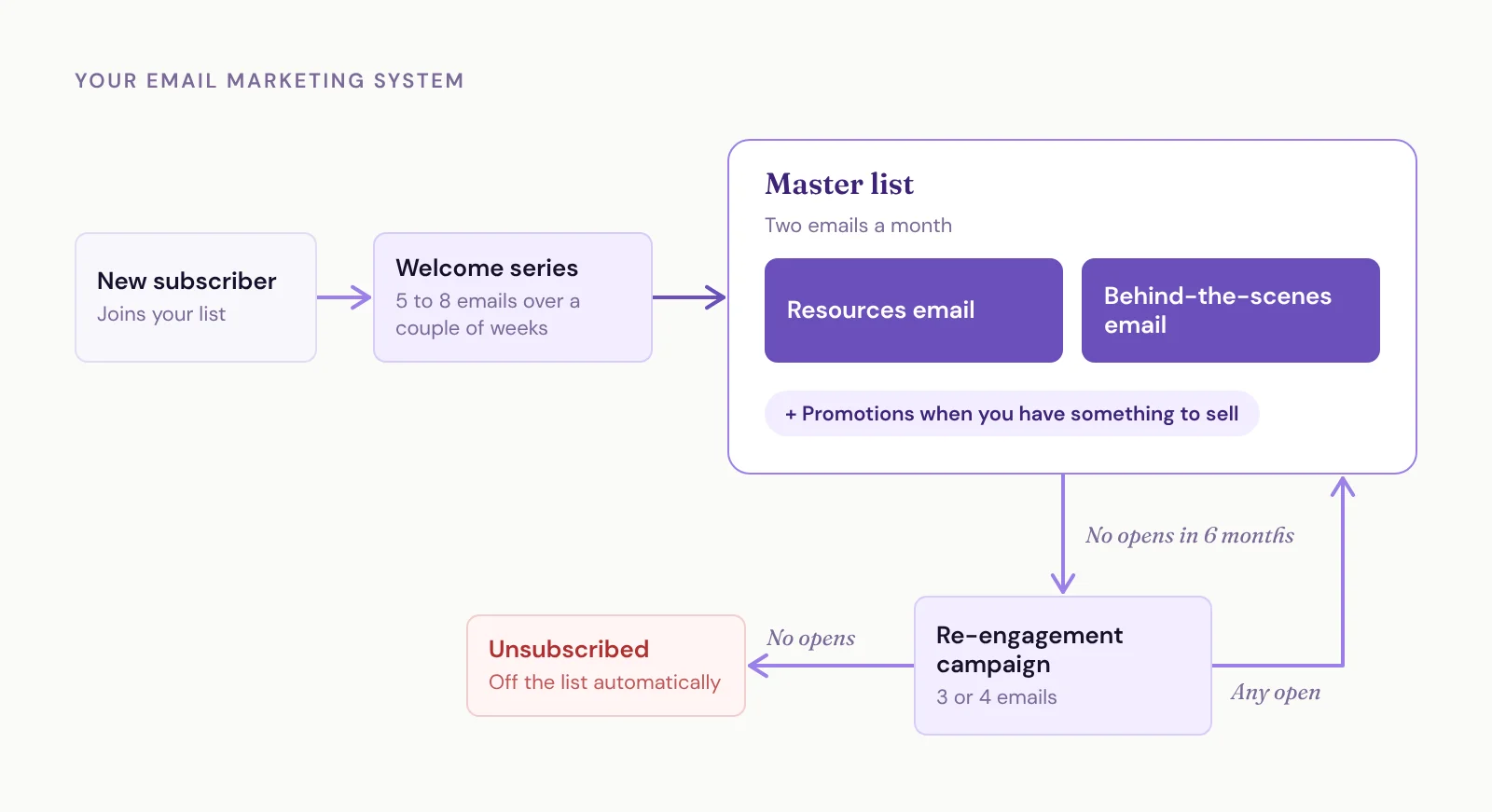
Two emails a month, a welcome series and a re-engagement campaign. That's the whole system.
Got a book launching, a course opening or a special offer to drum up business? Sprinkle those promotions in when they happen. They ride on top of the two regular emails, not in place of them.
Why bother? Your list holds two kinds of people: decision makers who can hire you, and content followers who can't yet. You never know which followers will get promoted, mention you to their boss or forward your email to the person who books speakers. Some will buy your book or your course along the way. I go deeper on what to do with attendees who can't hire you in another post.
None of that happens if you aren't in their inbox.
Why Most Thought Leaders Stop Sending
Most people either don't email their list at all, or they start and then fall off.
The first group has a weird association with email marketing. They picture the spammy stuff they get from someone they met once, and they don't want to be that guy. (For the record, when I say newsletter, I just mean those two emails a month. No confetti required.)
The second group wants to do it. They just don't know what to say. Every email starts from a blank page, and eventually they stop.
It's like going to the gym without a plan. Walk in not knowing what to do, and the odds you keep going are close to zero. Walk in with the workout already written, and there's way less resistance to showing up.
These emails are the workout.
Start with One Master List and Tag Everything
Before you write anything, look at your lists. Ninety-nine percent of the time, you need exactly one. We call it the master list.
Everything else is a tag:
Submitted a form? Tag them with the form name.
Downloaded a lead magnet? Tag them with the lead magnet.
Bought something? Tag them with what they bought.
Came from an event? Tag them (or fill in a custom field) with the event name.
When you want to email just one group, build a segment from those tags. We build this in Zoho Campaigns for our clients, but any email tool worth paying for has tags and segments.
There are real exceptions. If I ran SpeakerFlow and a taco truck out of the same email tool, those would get separate lists. Bureaus often need one list for speakers and one for clients, because the content is completely different. That's about it.
Most people create extra lists because they're trying to build segments and don't know how their tool works. Then every time they send to their "whole list," they're checking boxes on 10, 12 or 50 lists. Miss one, and those people quietly stop hearing from you.
That's exactly what happened to one of our clients. They had about 15 lists. When we consolidated them into one master list, we found a couple thousand people who hadn't been getting their emails, because one list never got selected at send time.
If you're consolidating, turn each old list into a tag before you merge it. If anything goes sideways, you can still find that group.
One more thing. This list lives in your email tool, not your CRM. I explain why you should keep subscribers out of your CRM in another post.
Email One: The Resources Email
Pick one problem your audience has, then hand them three to seven resources that help solve it.
Those can be blog posts, podcast episodes, videos or tools. Mix your own content with stuff other people made, roughly half and half. If you lean one way, lean toward your own.
Don't skip the curated half. Pointing people to someone else's great article teaches them you're a filter, and a good filter is an expert.
The shape is simple. Here's a problem you probably have, here's how to think about it, here are some resources to help, and reply if you get stuck.
Subject: [Number] resources for [the problem]
[One or two sentences on a problem your audience runs into, and why it's worth solving.]
Here are [number] resources that'll help:
[Resource 1]: [One line on what it is and why it's worth their time.]
[Resource 2]: [One line.]
[Resource 3]: [One line.]
If you get stuck along the way, hit reply. I read every one.
[Your name]
Always ask for a reply. More on why in a minute.
Email Two: The Behind-the-Scenes Email
This one lets you talk about the work you do without promoting it.
Tell a story from your work, share what you learned, then ask a question. For a speaker, it might go like this. You gave your signature keynote, someone came up afterward with a question that made you think differently, you took that question to the decision maker, and here's what came of it.
It also gives people a chance to get to know you. A peek behind the curtain, a personal anecdote, a lesson from the road. That's what keeps your emails from feeling like mass emails, even though they are.
Subject: [A short hook from the story]
I was recently speaking for [organization] in front of [number] people.
After my keynote, someone came up and asked me [the question]. It stopped me in my tracks, because [why it made you think differently].
[What happened next. Maybe you brought it to the decision maker, and here's what you worked on together.]
[The lesson, in a sentence or two.]
Have you ever been asked something like that? What would you have said? Hit reply and let me know.
[Your name]
What Happens When Someone Replies?
Replies are the best signal you've got. They tell you your list is healthy and people are actually reading.
Most replies aren't sales conversations, and that's fine. A reply becomes a lead when it turns into talking about working together. Once you're figuring out a sales call, that person belongs in your CRM as a lead, with the same one-to-one follow-up you'd give anyone who asks to hire you.
The Welcome Series: Warm Up New Subscribers First
Everyone who joins your list gets a welcome series before they get your regular emails. Five to eight emails over a couple of weeks. Here's the order we use:
Welcome and intro. Who you are, where you're from and how you got into this.
Solve their problem. Help with the most common problem you solve, through a story or a couple of concrete steps.
Bonus resource. Something valuable they weren't expecting.
Behind the scenes. A story from your work, same idea as above.
The offer. Make an ask. For most speakers and coaches, that's a strategy call. This teaches people you sell things here, and there's nothing wrong with that.
Client success story. Social proof that backs up the offer.
Offer reminder. One last call.
What to expect next. How you'll show up in their inbox from here on.
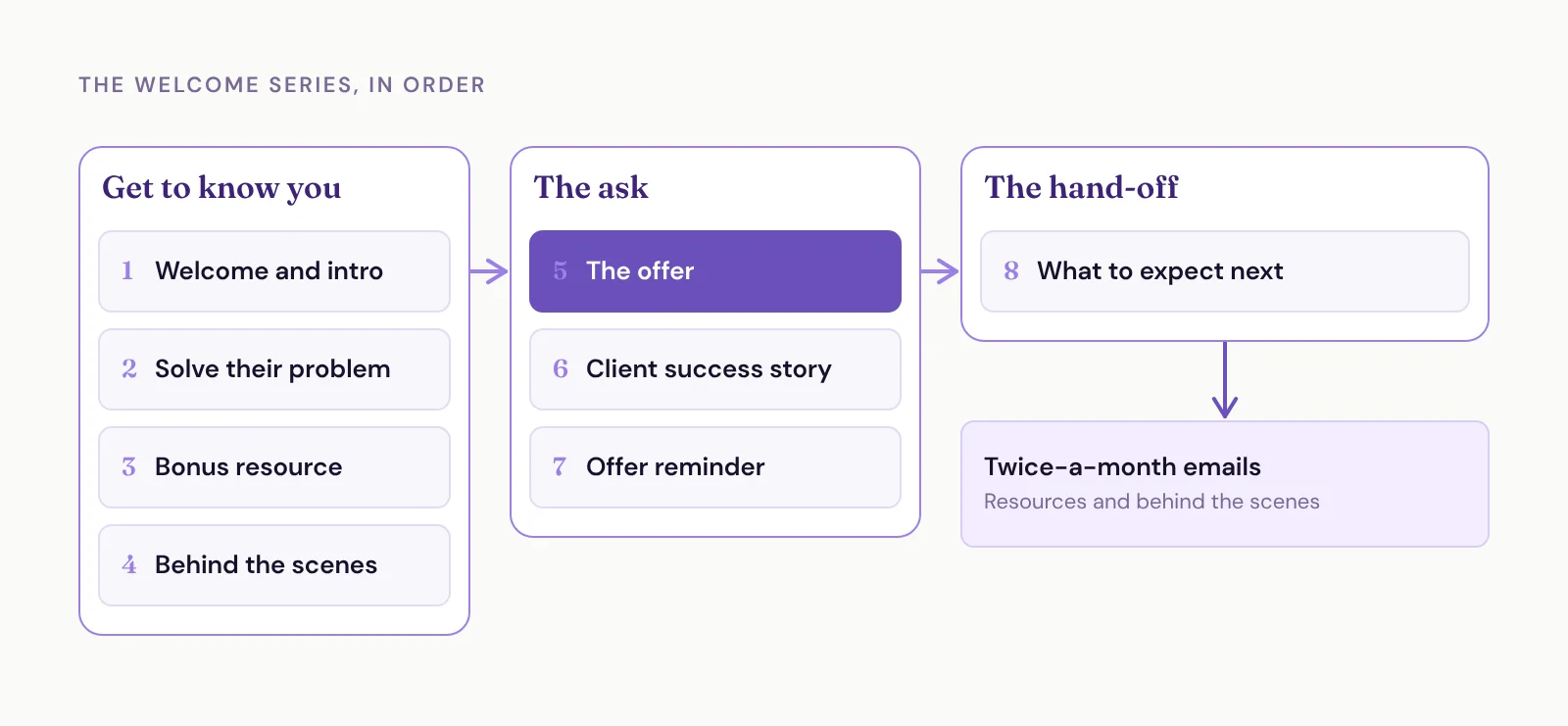
That last email matters more than people think. It tells new subscribers what's coming, so your next email doesn't feel random. Link update your preferences to your email tool's preference page.
Subject: What to expect from here
Over the last couple of weeks, we've talked about [X, Y and Z]. I hope it's been helpful.
Going forward, you'll hear from me about twice a month with resources, stories and takeaways on [the problem you help with].
If you ever want to [update your preferences], you can. And if you ever want to unsubscribe, the link's at the bottom.
When I send something your way, feel free to reply. I answer every one personally.
Talk soon,
[Your name]
In a perfect world, people in the welcome series don't get your regular emails until they finish it. Here's how we handle that at SpeakerFlow. When someone enters the series, they get an "in welcome series" tag. Newsletters go to a segment that leaves out that tag. When the last welcome email goes out, the tag comes off.
The Re-engagement Campaign: Clean Your List on Autopilot
If someone's been on your list for more than six months and hasn't opened anything in six months, they automatically get a re-engagement campaign. Three or four emails over a couple of weeks.
The moment they open one, they're out of the sequence and stay on your list. If they don't open any of them, they're unsubscribed automatically.
That might sound harsh. But a pile of people who never open isn't doing you any favors. Inbox providers watch how people engage with your emails, so a big chunk of never-openers can hurt whether your emails reach the inbox at all. And most email tools charge by contact, so you're paying to email people who aren't reading.
In the emails below, link unsubscribe here to your unsubscribe page and rejoin here to your signup form.
Subject: [Your best subject line, about something useful]
[A short story or a few resources, same as your regular emails. This one has to earn the open, so spend your time on the subject line.]
[Your name]
P.S. You're getting this because I noticed you haven't opened my emails in a while. If you'd rather not hear from me anymore, you can [unsubscribe here].
Subject: Still want these?
Let's call a spade a spade. You haven't opened my emails in a while, and that's totally okay.
I take list hygiene pretty seriously around here, though. If you want to stay, you just did the hard part. Opening this email means you're officially safe.
If you'd rather go, you can [unsubscribe here].
[Your name]
Subject: Should I take you off my list?
It looks like my emails aren't reaching you, so I'm going to respectfully take you off my list.
If you ever want back in, you can [rejoin here]. Thanks for being here.
[Your name]
P.S. If you're reading this, you're safe. Opening this email keeps you on the list.
What If You Haven't Emailed Your List in a While?
Don't just pick up where you left off. Do this first:
Combine everyone into one master list.
Export it and run it through an email verification tool, which tells you which addresses are good and which are bad.
Remove the bad ones.
Send everyone a "here's the new plan" email. Tell them you'll be in their inbox about twice a month and what you'll send, and make it easy to unsubscribe if that's not for them.
Start the system: two emails a month, a welcome series for new people and a re-engagement campaign running in the background.
How to Tell It's Working
Watch three things after every send: opens, clicks (when there's something to click) and replies.
Don't obsess over open rates. Apple Mail marks a lot of emails as opened automatically, so the number runs high and doesn't tell you much on its own. Compare each send to your own average and watch the trend.
The more useful number is click-to-open rate: of the people who opened, how many clicked. Across the 3.6 million campaigns MailerLite analyzed from December 2024 to November 2025, the average was 6.81%. If you're in that neighborhood on emails with links, you're doing fine.
If opens drop well below your normal, work on your subject lines. If clicks are low on an email that has links, the links probably weren't clear enough, or there were too many. And keep asking for replies in every email. You're training your list to talk back.
How Long This Actually Takes
Thirty minutes to an hour a month, tops. Especially with AI in the mix.
Batch them if you want. Write both emails in one sitting and schedule them two weeks apart.
AI can draft them for you, but only once it knows how you sound. My tip: have Claude go through your sent emails and your meeting notes, and use that as its guide to your voice. Then review what it writes before anything goes out.