"We're a small bureau running on Airtable, Trello and HubSpot. What should our system look like?"
I get some version of that question a lot. My answer is one CRM at the center of the business, with your talent, your deals and your paperwork all linked inside it, and everything else feeding into it.
That's what we want for every client, speakers included. But a bureau's CRM has to do a lot more than a speaker's. From an architectural level, a bureau's system is much more sophisticated, and it needs more automation and integration to make your life easier.
The Tools around the CRM Are the Same. The CRM Isn't.
Zoom out and a bureau needs the same supporting cast as any business. Email marketing with a good process behind it. Forms for capturing info. Invoicing and accounting. Social media, surveys, e-signatures, and all that jazz.
Zoom into the CRM, and this is where things get really interesting.
A speaker sells one thing - themselves. A bureau sells a roster, to clients, through a team of agents, with paperwork going both ways on every deal. The CRM has to do more.
The Most Common Mistake: Nothing Is Connected
When a bureau sets up its own system, the mistake I see most is that it isn't integrated with anything.
Events live in one tool. Checklists live in another. Deals and invoices live in a third. Your agents get confused about where to look for what, everything is really manual, and because everything is slower, you can't make as much money as you should.
When everything's integrated, easy to find and in one place, and the system guides your team through a defined flow, they can focus on making money instead of figuring out where to go. If the patchwork sounds familiar, here's why so many teams buy a CRM and still live in spreadsheets.
Give Your Talent a Database of Its Own
A normal CRM has leads, contacts and deals. For bureaus, we add a custom module for your talent. For a speakers bureau it's Speakers. For an authors bureau it's Authors. For a talent agency, it's whatever the right word is for your roster.
That module is the central database for everyone you represent:
Their name and where they travel from
Their preferences
Their bio and headshots
Their fee range
Their topics
A link to their profile on your website
Every deal you've lined up for them
That's what makes matchmaking fast. When a client asks for someone who fits their topic and their budget, you search the database instead of your memory.
Track Who You Pitched, Not Just Who You Booked
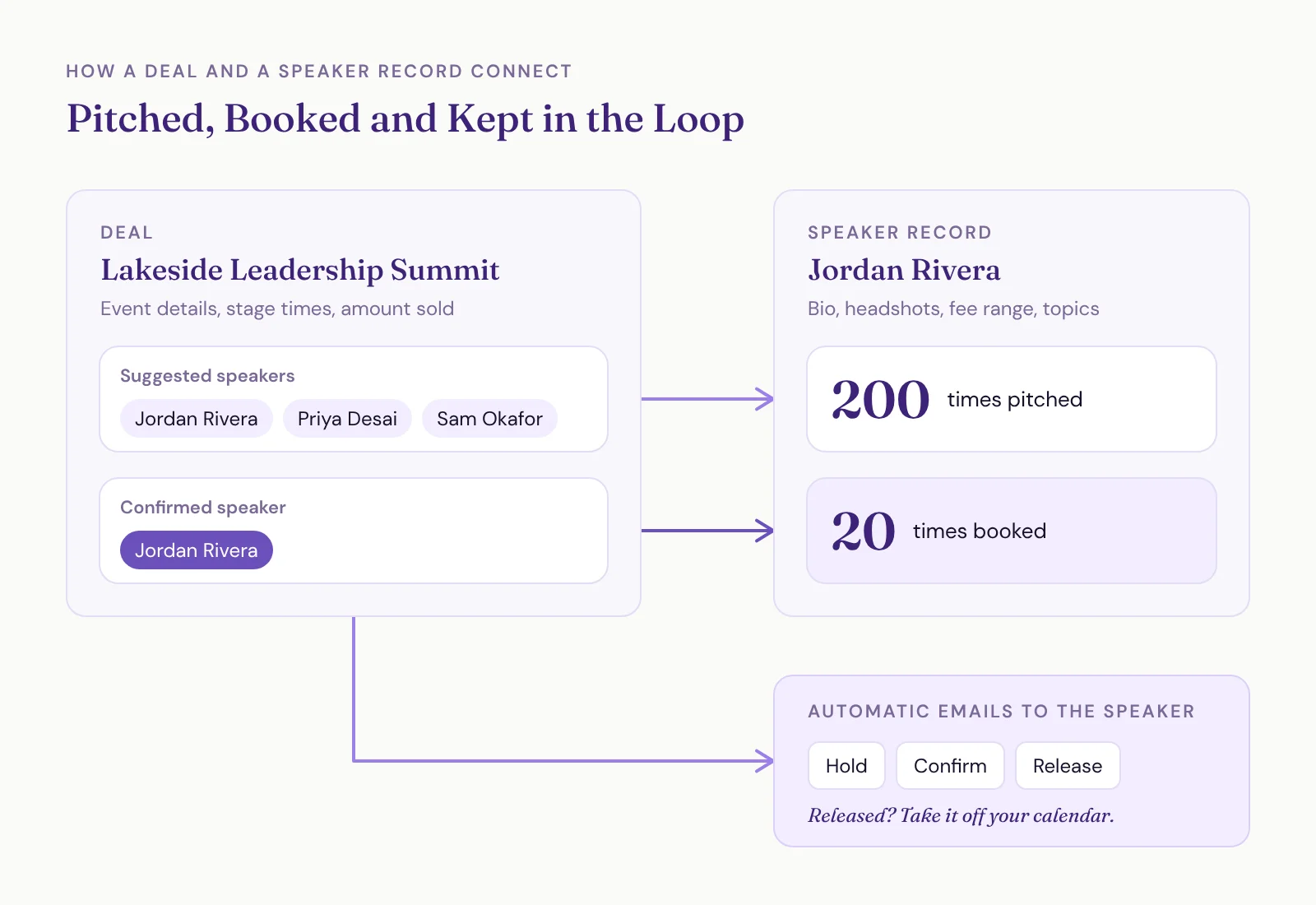
Bureaus usually suggest a few speakers before they confirm one. So the deal links to your speakers module in two ways: which speakers were suggested and which were confirmed. Both are multi-select lookups on the deal.
That information shows up on each speaker's record. If you've booked a speaker 20 times, you see it right there. You don't have to dig through your deals to find it. And you can also see you pitched them 200 times, because they were suggested that many times.
Once deals and speakers are linked, you can do some really fancy stuff. When you hold or confirm an event, the speaker gets notified automatically. When an event is released, the system emails the speaker to tell them, so they can take it off their calendar.
Let the Deal Fill Out the Firm Offer Form
Most bureaus send their client a firm offer form. It collects the event details and, in essence, the contract info.
We build it as a custom form generated from the deal record. The deal pre-fills the form with everything you already know. Your client fills in the blanks or fixes anything that's not accurate. When they submit it, it updates all the fields on the deal, so you can issue a contract that's already filled out.
The form gets attached to the deal, and everyone's notified.
The rest of the paperwork works the same way. The big ones for bureaus are usually a master services agreement (MSA), often good for a few years, a statement of work (SOW) for each event, the firm offer form and sometimes a proposal. All of it should come from the deal, not get retyped. I've already written up how contracts fill themselves out from the deal, so I won't repeat it here.
Let the Deal Do the Commission Math
This is a great one. On every deal, you want to know how much the bureau is actually making.
Here's how we set it up:
The deal holds the total amount you sold the event for.
Each speaker's commission percentage lives on their speaker record.
A bureau profit field on the deal does the calculation.
That matters because the split isn't the same for everyone. One speaker keeps 75%, so the bureau takes 25%. With another, the bureau takes 20%. The bureau profit field reads the rate off whoever's confirmed and updates on its own.
If co-broker splits are part of your world, our podcast episode on how speakers, bureaus and management companies split commissions walks through how those work.
Give Your Speakers a Portal
Keeping a bureau updated is a huge pain point for many speakers who work with bureaus.
So we build custom portals. Your speakers log in to update their bio and headshots, see which events they've been booked for and view all of their information in one place. The bureau stays up to date without chasing anyone down for a new headshot.
Build for a Team of Agents
Most bureaus have more than one agent. That changes the system in a few ways:
New leads are assigned round robin, so they're spread across your agents.
Task workflows follow the deal owner, so the right agent gets the right tasks.
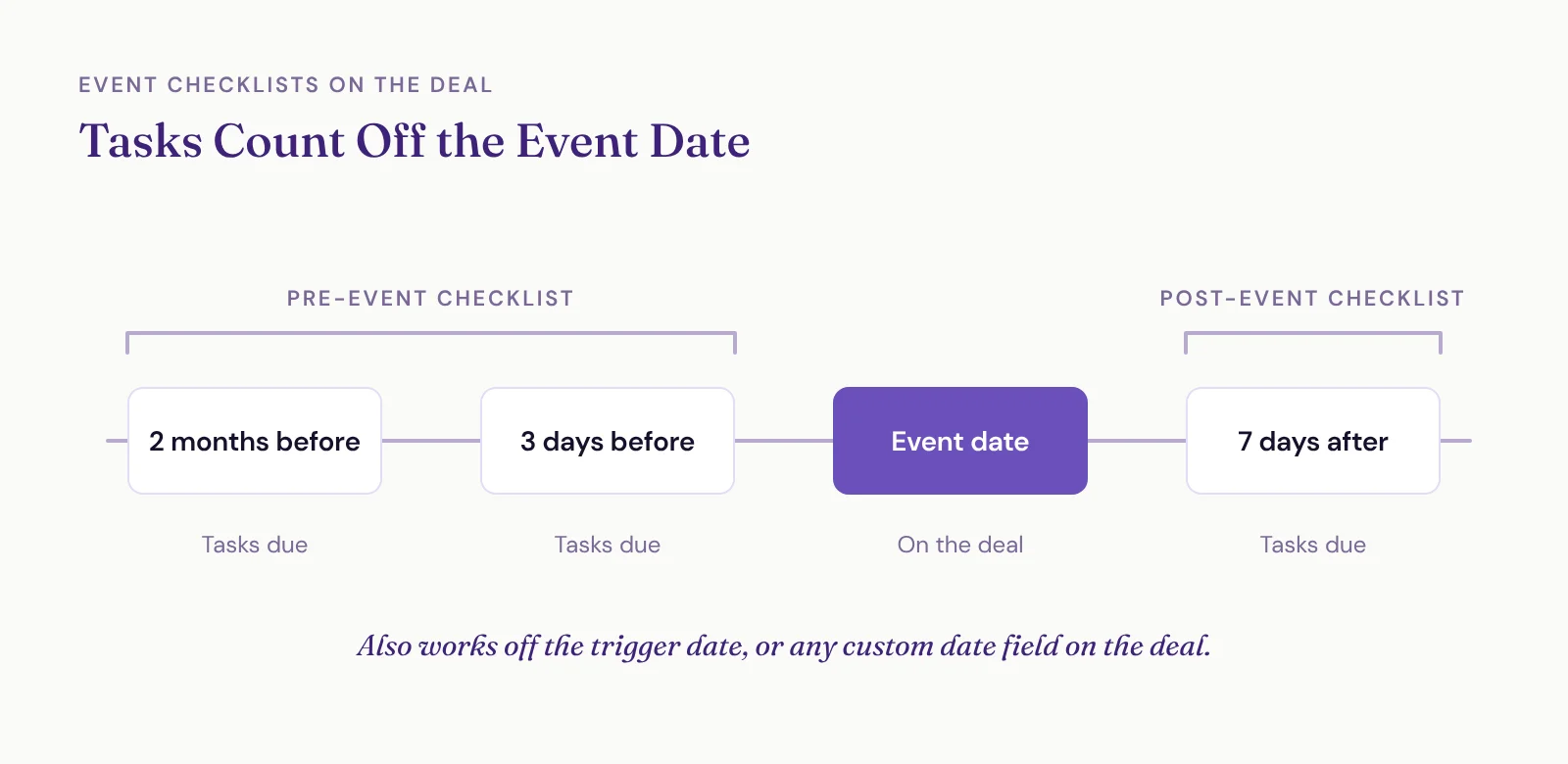
Pre- and post-event checklists go out automatically.
That last one is where most systems fall short. Usually, task automation only runs off the trigger date, the day the workflow fired. Nothing counts off the event itself.
We set tasks off any date on the deal. Two months before the event. Three days before. Seven days after. The trigger date, and any other custom date field you track. That way every event checklist lives in the CRM, linked to its deal, instead of in a separate tool.
Itineraries can plug in too. We can integrate Travefy and other itinerary tools as well.
What Happens Once It's All Connected
Once this infrastructure is in place, you can actually make the most of AI.
The bureau I've worked with the most is a good example. We've been building their system together for years. Once the foundation was there, we built AI skills on top of it. The owner told me straight up that because of those skills, they don't have to hire two administrative roles, which saves them $150,000.
That only works because the data underneath is connected. AI can't do much with three tools that don't talk to each other. It's the same reason I'd put AI to work on operations first.
How Do You Switch without Slowing Down?
The pushback I hear most from bureaus is "it's not a good time." I'll level with you - it's never a good time. Especially with bureaus.
So we rebuild the airplane as it's flying. I don't want any bureau thinking their business is going to slow down because of the switch.
We don't build every piece before launch. Together, we decide what the essentials are and what a successful launch looks like. Then we spend 90-plus days refining, iterating, phasing your team into the new system and getting everyone trained up.
Two more I hear a lot:
"We're not that big. It's just the three of us." I get that one a lot. The real question is whether you want to grow, or get your time back. Doing everything by hand lets things slip through the cracks, and it caps your own potential.
"Everything we've looked at is just more fragmentation." That's usually because nobody is building the system you actually want, and there's nobody you can just talk to in outcomes. That's an implementation problem, and it's why so much software never sticks.
So, budget aside, is the pain high enough to solve now? Because waiting caps how far your bureau can go.