David: You cannot be a same ol' speaker. You cannot be in the middle of the road. The middle of the road has that big double yellow line. What do you find in the middle of the road? Roadkill. If you want to be roadkill, then you can hedge your bets, then you can play it safe, then you can hope not to offend anyone and be another leadership speaker or another sales speaker or another motivational speaker or another customer service speaker. Or just another culture speaker, and you will be completely invisible.
Austin: Alright. Well, I'm so happy you're here. I was doing a little bit of internet research. I actually, Austin personally and SpeakerFlow as a company, pulled back far from social media. I am off all channels. I'm not paying attention at all. SpeakerFlow is active on LinkedIn.
David: Isn't it great?
Austin: It's so much better. Yeah, it's so much better.
David: I haven't been on Facebook for personal since two months, and I see no reason to go back. At first it was just a little experiment, right? What if I don't go on this week? That worked great. What if I don't go on for two weeks? That's pretty awesome. What if I stay off a month? Good. I'm feeling better and better the more I stay off. So I didn't go back.
Austin: Yeah, I think many people are well served to do that. We actually just released the State of the Industry Report. Have you looked at that yet? The State of the Industry Report?
David: I have. Yeah.
Austin: Okay. One of the stats in there that shook me was that on average people are spending almost a third of their week on social media to generate two and a half percent of their revenue. It's like, why are we doing this?
David: If that. And many times it's zero percent.
Austin: Yeah, it is for sure. Yeah. I did find your Instagram page, though, while I was looking, and I noticed that you had a picture of a Casio watch on there. And Casio is like S-tier watch company for most people. So are you like a watch guy? Do you have a collection, or...?
David: Yes. Those are watches and watch boxes.
Austin: Yes. Yeah, that's what's behind you there. Man, I got a tiny video. Wow.
David: Yes. So I also, just purely for fun, I started a watch podcast. So now I have the business podcast that's been going forever. And I just started this watch podcast about two or three months ago. And I just do it to learn. I just do it to talk to people. I've had dealers, micro brand folks, salespeople, watch collectors, just watch aficionados. It's been great, and so yeah, it's just a ton of fun.
Austin: Wow. I feel like I'm always just learning something new about you, David.
David: It's always something new and something crazy in Newmantown.
Austin: That's right. Why watches? What caught your attention about that?
David: Well, I've always liked watches, and then just the last year or two, I've started collecting watches almost impulsively, obsessively. Not expensive watches, but Timex, Casio, Bulova, just weird, funky, strange watches, funky designs, weird colors. I love orange, I love purple, I love all these wacky things. Typefaces, really cool typefaces on the dial. And it just became a thing, and it started being like this full-time hobby.
Austin: Wow. Well, I respect it.
David: And then I figure for the tax write-off I better start a podcast.
Austin: Yeah, now we're talking.
David: No, no, Your Honor, that was a business expense because I have a watch podcast, of course. Yeah, obviously.
Austin: Obviously. Yeah, come on. Do you have a favorite? A watch that you always are coming back to, or is it just, you like mixing it up, or?
David: I do have a favorite. So the most meaningful watch I have is also my most expensive watch, and it's my only expensive watch, which is my Rolex that I got back in 2015, and that was for a business milestone, and it was a reward that I set for myself a long time, and then I hit it. But then my day-to-day $250 watch that I love is my Bulova Jet Star, which has this really cool dial. It's like a retro, retro model. It's current, but it has a retro design. And it also has the Precisionist movement, which is a quartz watch, but it's eight times the frequency of a regular quartz watch. So the second hand just sweeps totally smoothly. You can't even see it ticking.
Austin: That's so nice. Yeah. I love, Seiko does some really cool stuff in that department too. And that's smooth second.
David: Yes. Huge Seiko fan also. Whenever someone, I'm on some of these Facebook groups and some of these boards and whatnot, and people go, "Man, I don't know, I had to get this watch. It's so amazing, and it's my forty-seventh watch," or whatever. I always make the comment, I say, "If watches weren't fun, you would need just one." But the problem is watches are fun, and that's why you end up with a hundred and fifty watches.
Austin: It's so true. Yeah. Which I respect. Everybody's gotta have their thing. So you put in our show notes a phrase that stood out to me because it was paradoxical of sorts. And that was, I think you called it, being a business celebrity, becoming a business celebrity. This is a systems show, and I can't think of a single time in my life where somebody systematically became a celebrity. It seems like oftentimes it is luck or chance. So I'm curious, why is that the angle, an angle, maybe not the main angle, but why is that an angle that you take here that seems very contradictory to what most people talk about as it relates to growing their personal brand?
David: Contradictory to what most people talk about, no sweeter words have ever been said to me. That's exactly what I'm saying. So, man, there's so much richness in that question. So, becoming a business celebrity, a lot of people think that's about just random, right? You have a runaway TEDx talk, you have a runaway book. You suddenly, someone, the right person was in that audience, and they just suddenly made you a star. I think you can totally systematize, can't systematize my mouth, but you can totally become a business celebrity in a systematic way. And here's what I think it takes. I think you need to be radically different, radically generous, and radically helpful to your audience, to your target market. And the beauty of SpeakerFlow and the beauty of systems that automate a lot of this, automate, interconnect, streamline workflow. Doing this manually is really, really hard.
David: But if you have unique points of view, you have distinct sound bites that are head turners that go, "Wait a second. Did she really say that? Did he really say that?" And you can load those up into your social media. You can put those all over your website. You can propagate those on LinkedIn. You can send emails to your email list about them that are provocative, that stir the pot, rock the boat. They don't just sound different, but they are different because, Austin, I think here's the deal in Speakerland. We used to have a lot of these differentiators, and we used to have a lot of these celebritizers. And I'll give you some examples. It used to be that back in the 1990s, people said, "There's this new thing called the internet. You're gonna love it. But I'll tell you what you need: you need a website." And then there were speakers with websites and speakers without websites.
David: Then, of course, high quality video became available, YouTube, right? 2006, I think. Man, there's speakers that have amazing YouTube channels and speakers that have no YouTube channel or an average weird YouTube channel with them in their pajamas. So now the YouTube channel was the differentiator. Then of course, everyone got bitten with self-publishing, because self-publishing was hard back in the early 2000s. Around 2010, 2012, it became much, much easier. Now you had a book, and a book was the big differentiator. Well, you have to be the speaker that has the book. You can see where I'm going with this. All of these things now are total commodities. All of these things are complete table stakes.
David: In fact, the thing that's really getting my goat now is you'll have these speakers that do these video shoots, and then they AI enhance the staging. I'm sure you've seen this, right? They AI enhance the staging. They AI enhance, "I was in front of a room of 20,000 people," and it'll have a little tiny footnote somewhere, maybe if they're ethical, little tiny footnote: "AI enhanced portions of this video were AI enhanced." And some people forget to put that on there. And some people put it white text on a white background so no one can really see it. But anyway, today, all of that can be done by AI, right? We can have an amazing website, fantastic video, books that look like they're Wall Street Journal bestsellers, beautiful cover design, amazing layout, fantastic formatting, video that looks like you're in front of 25,000 people. So I think our buyers, meeting planners, conference producers, association executives, they're totally hip to this, right? You're not fooling anybody when you put this AI slop in front of people.
David: The differentiator that you have available today, and all of those are now gone, right? All of those are now table stakes, rear view mirror, kiss that goodbye, 2017 called, they want their marketing back. But today, if you are a radically different voice, if you're saying things, doing things, sharing practices, principles, and frameworks that other people are, they're just making it way too hard. So you are the great simplifier of complex ideas, you are the great democratizer and popularizer of formerly difficult subjects that now through you, because you have this radically different, radically generous, radically helpful, I'll come back to those three things. Radically different, radically helpful, radically generous frame on all of that. What you say and how you say it at scale through automation and technology and systems is the only arrow you have left in your quiver.
David: Interestingly, if you do that consistently and systematically over a period of time, you will elevate yourself so far above the crowd that you will not only become the best choice, you will not only become the safest choice to a lot of these meeting planners who are always looking for what's new, what's different, what's provocative, what's exciting, what's gonna get my members talking, what's gonna get my audience buzzing, you're not only gonna be the best, you're not only gonna be the smartest and the safest, you're gonna be the only choice. The only choice. So imagine if you took a system like SpeakerFlow and you loaded it up with every single touch point, whether it's an email, whether it's an agreement, whether it's a social media post, whether it's a newsletter, whether it's your outgoing voicemail, whether it's your autoresponder when you're on vacation. And every one of those touch points met the test. Is it radically different, radically generous, and radically helpful? And you are in fact now a business celebrity, if you can do that over a sustained period of time with genuine value and genuine care for your audience and your clients.
Austin: Mm-hmm. Man, you just connected so many really important dots there for people. And actually, as you were talking about this, it reminded me of something I read the other day that's tangential to the types of people that you and I work with, but still relevant, I think. It was somebody that was posting about how they had just finished building five iOS apps with AI. And they had published all of them, and after X number of weeks, a while, they had exactly zero downloads on any of them. And the point that he was making was, for the longest time, people were saying that in order to get into the software landscape, for this person, the thought there was that you had to have a technical co-founder, you had to have deep technical expertise, blah, blah, blah, all about building this thing. And AI completely eliminated that and revealed that there is actually a second half of this, which is getting people to use your apps.
Austin: And for the longest time, both of those things felt so impossibly difficult that you couldn't even parse them out. But now that creating the thing has become so easy, it's really shown a spotlight on how difficult it is to actually get people's attention. And that's a whole different skill set that you have to have. And I think it's a similar thing that's happening here, where the assets that are required to promote yourself are no longer a barrier. To your point, you can go have AI build you an awesome video, write you a book, do all the design on the inside, build you an awesome website, conversion rate optimize it. All of those technical things are no longer a barrier anymore. But I even think, maybe just in these last few years, it's different as technology has progressed. Having those assets were never really the thing that was gonna create the sustainable business, anyways. Maybe some people got lucky on it. Okay, I'm not gonna say it's impossible, but I think most people, even if they had all of those assets, still would struggle. And I've seen that anecdotally with all my clients for so long.
Austin: And so it seems like really trust is a huge thing. And I think as you were talking about the AI enhanced videos, it reminded me of another post that Jamie Nolan, the CEO of the National Speakers Association, published recently, where meeting planners have never been more distrustful of something like a video before, because they keep getting burned by people that seem like they're amazing when they're actually not. So trust is a big one. But it also reminds me of a conversation that we had with Chris West, a video narrative, years ago, who said that from his perspective, those that are doing the best right now are the ones that are the most controversial. And I think that connects a little bit to what you were saying there, because controversy inherently means it's not in alignment with what everybody's thinking. And so it causes arguments, and that causes engagement, and that gets a name out there easier than other ways.
David: For sure.
Austin: And so I don't think that we need to be controversial for the sake of being controversial, but I do think there's something to be said about calling yourself a thought leader. And many of the people in this industry do. To be a thought leader means that you're sharing ideas that are not what everybody else is sharing. You're leading the front, right? And it seems like there's some connections to what you're talking about there.
David: Yes, very much so. Let me go back to the assets conversation for a moment, because you totally put your finger on it. I cannot tell you how many times people come to me and they say, "David, you've written four books. I need to write a book. If I write a book, the whole world's gonna open up to me." And this doesn't matter, this next little bit here, whether it's AI, not AI, who cares? Here's what I tell them, Austin. I say, "Hmm, so you think all your problems will be solved if you write a book?" "Yes." "Okay. Well, I'll tell you what, through the magic of David Newman and David Newman hand gestures, this is your book." Now technically it's not their book, because it's my day planner. But I say, "Tell you what, let's fast forward the clock. You've done all the work, spent all the money, taken months and months and months. Here's your book. I'm gonna hand you this book. This is now your book. There's a warehouse full of these, Amazon's locked and loaded, everything is ready. What's the first thing you're gonna do?"
David: Austin, I will tell you, to a single person, I must have done this twenty times over the last ten years, the answer I get is something along the lines of, "B... d... but... e..." They have no freaking idea. So, to your point about, is it easier to create the app or market the app? Is it easier to write the book or market the book? Right? Writing the book, coding the app, that's not the challenge. And even, let's take AI out of the equation. I'm gonna say writing the book by hand and coding the app by hand. Hard as that was, that wasn't the challenge then either. It's, how do I get eyeballs? How do I get eyeballs? How do I get economic buyers to consume the thing so that they hire me? No one has a plan for that. They're totally clueless. They're totally mystified. I'm not mystified. You're not mystified. The answer is systems, delegation, automation, and systems. You need a machine, right? You think you might need a machine to create the thing. Maybe, maybe not. You definitely need a machine to market the thing. Market and seed and plant and put it in front of as many human beings who have checkbooks in your world, whatever that means in your target market.
David: No one thinks about that. They go, "I just have to have a book." And again, as someone who's written four books, I know that writing the books is the easy part. Writing the books is the fun part. Try writing a hundred emails. Try writing 50 social media posts. Try writing 50 LinkedIn articles that go out to all your subscribers. Not just once. Not just, "Let me put myself in a cave for a few weeks and crank all this out." I'm talking about day after day, week after week, month after month, year after year for the rest of your professional life. If you think you can do that with File, Open, tap, tap, tap, and not use a system like SpeakerFlow, and not use some sort of smart automation, delegation, propagation that can get this out in bulk, in the right places, in the right timing, with the right cadence, in front of the right audience, you're crazy. You're crazy. So if you're not on board, and these are the three things. Well, when I tell people who are, "I'm overwhelmed," the three words I use, Austin, literally, it's simplify, automate, and delegate. And delegate can be to a person or to a platform, right?
David: Simplify means stop doing the crap that you don't need to do in the first place. And right before we turned on the mics, we were talking about the SpeakerFlow survey, the annual survey about the speaking industry, and what percentage of people are wasting enormous buckets of time on social media. And social media is responsible for zero to maybe two percent of their business, but they spend 30%, 40% of their life on social media. That would fly in the face of simplify, because you shouldn't be doing that at all. Simplify, automate, delegate. And so, yeah, that is a huge, huge misconception. Is, "I just wish I had the app, I just wish I had the book, and then I'd be successful. I just wish I had the AI generated video. And then I could sucker more meeting planners into hiring me when I actually suck."
Austin: So true. Fighting words.
David: I'm sorry, did I say that out loud? Did I just say that out loud? I know.
Austin: No, you're right. It's so true. Well, people look at it like they're trying to just extract money from people. I think it's so easy to forget that what we're doing is a service-based business. Your job is to love on people and solve their problems. And the fact that you get paid for that is not the main thing that we're going for here. Because if it is, you're not gonna get paid very often. Because there's just enough people out there selling things. That's not the point. Just because you have something to offer doesn't mean that somebody wants to work with you. And I think this actually connects right back to where you start here with your three major radically valuable... Can you give me the three again?
David: Radically different, radically helpful, and radically generous. Yeah.
Austin: There you go. Yes. Those are so good. How did you land on those three, by the way? Of all of the things to land on, why are those three?
David: Well, so my latest book, you always have to have an interview where the guy says, "My latest book," but my latest book, truly, Market Eminence, is answering the question, in this crazy, noisy, AI fueled world that we're living in, what does it take to actually earn attention? And there's three components. One is visibility, so you have to be visible, but not everywhere, just where your economic buyers are. You have to gain a level of marketplace respect. Respect is the second category. So I break down, well, what do respected brands do? What do brands like Apple and Toyota and BMW and Tiffany, what do they do? Right? Well, what they do, whether it's a B2B brand or a B2C brand, huge company, small company, doesn't matter, they're radically different. Right? They're different than all the other Samo Lamo look-alike competitors. Meaning they say different things, they look different, they behave differently. You can pick up their vibe, you can join their movement, so to speak. They're not just the commodity brand that's selling stuff. So that's number one.
David: Number two is radically generous. They're always filled with surprise and delight. They give gifts regularly, they give more than people pay for. So you can look at all the different brands that you love and think about, what are the examples of where these brands are giving more than what's paid for, more than what's necessary? And then radically helpful. They actually help you solve a problem. You mentioned problem solving. And I also want to reframe, for most of the speakers listening to us, you're not a professional speaker, you're not a professional coach or consultant or trainer. You need to be a professional thinker and a professional problem solver. And if you're a professional thinker and a professional problem solver, and you meet these three criteria of gaining marketplace respect, which is radically different, radically helpful, radically generous, then you go to the third phase of market eminence, which is simply brand preference.
David: And brand preference means, hey, you're on the short list to, hey, who's the safest choice? Who's the smartest choice? Who's the choice that's not gonna get me fired? "Oh my gosh, we have to get Austin. We have to, he's the only choice." So we're moving from safest, smartest, best to only. And that's because you're visible in the right places to the right people. You've got the marketplace respect that you've earned, right? You've earned your stripes, you've earned your reputation by doing things, saying things, and being the person who is radically helpful, radically generous, etc. And then the economic buyer says, "Well, there's only one. There's only one Austin." You can't, I call it the black marker test in the book. That you can't take a black marker, black out the logo, black out the name, and then go, "That looks like everybody else." No, "I know who that is. Even without the logo, even without the name, that sounds like David Newman." Right? "That sounds like Austin Grammon. That sounds like that comes from Apple. That sounds like it's a BMW ad."
David: And when I put it in those terms, right, you know what the voice of those brands is. What you probably don't know, because you haven't worked on it yet: well, what's my brand voice? What's my unmistakable signal in the marketplace that's gonna be both very attractive to my ideal client, and it's gonna repel people that I don't want to do business with? And it's gonna repel people who don't share my worldview and my values and are not in alignment with the kind of work that I wanna do, the kind of fees that I want to charge, the kind of audiences that I love and wanna be in front of. So that's the other thing, and we can talk about this if you want to. If a brand is truly magnetic, like electromagnetic, to its target market, it will also be incredibly repulsive to people who are not a fit. And I always say, there's two parts to that last sentence. Incredibly repulsive. Why would I want to be incredibly repulsive? Incredibly repulsive to people who are not a fit. Right? The nightmare clients from hell, the people that will nickel and dime your invoice, the people that would say, "What? You charge $10,000? We could never charge $10,000. What do you have for $500?" Nothing! Nothing for you! Because you're a goofy cheapskate that doesn't understand what I do or who I do it for or its impact or anything else. So incredibly attractive to the right people, incredibly repulsive to the wrong people.
Austin: Ugh. I think I'd be curious to hear your opinion about this, because I come at this from maybe more of a nuts and bolts angle than maybe you do. You're very strategic. And I know that you obviously are helping people implement too, I don't mean to overgeneralize, but I think for a lot of people, the psychology behind not doing that is mostly fear of loss. They feel like by not getting restrictive like that, that there's actually more opportunity. And it's totally counterintuitive, but it seems to me that the more restrictive one gets, the more opportunity there is, because you're more differentiated. And it's hard, I think, for people to really wrap their arms around that and make peace with that. But I think so many people don't take that leap because they're afraid that by repelling anyone, they're actually missing out on money. And it goes back to the Chris West thing. The controversial bit is exactly that, is that some people really deeply agree with you and some people really deeply don't. And that in and of itself is very valuable outside of qualification, but even just because people talk, and it's way easier to talk about something that you agree or don't agree with than something that's just lukewarm. Is that what you see too?
David: Sure. Absolutely. My God. A thousand percent. So I'll give you two very quick examples. One is a celebrity speaker and one is a non-celebrity speaker. So the celebrity speaker, that some people may know, but less and less because I'm old, they're young, whatever. But Larry Winget. Larry Winget is the perfect example. Very, very, so kids, you can look him up on Wikipedia, very, very successful professional speaker. And he marketed himself, he's retired now, but he marketed himself as the pit bull of personal development. The pit bull of personal development. And he first came to fame with a bunch of books. The first book really took off, New York Times bestseller. And it was called Shut Up, Stop Whining, and Get a Life. And then he followed that up with books like You're Broke Because You Wanna Be, and It's Called Work for a Reason was another book.
Austin: Those are great names.
David: But my favorite book of his was actually a parenting book. He's a business speaker, but he had a parenting book called Your Kids Are Your Own Damn Fault. Now, think of all the people that would be repelled. It was, "My God, we can't have this guy at our meeting. That's offensive. That's not, my gosh, that's terrible. You can't say those things out loud." And at the same time, right, these are the HR types, the nicey nice, make nice with everybody. And then there's the CEOs and the conference producers and the meeting planners that go, "This guy, this guy's gonna bring a harsh kick in the pants and a real dose of reality to our audience. I love this guy. No one is this in your face, no one is this ballsy, no one is telling it like it is, like Larry Winget." And so he had super fans. And he had people that would not touch him with a 10-foot pole for any reason under any circumstances. And he made a very, very nice living. He ended up with a TV show. He had a TV show for a while on cable, national show. Many, many multimillion dollar book deals, six-figure speaking fee.
David: He did not mind if you weren't his cup of tea, if he wasn't your cup of tea. He knew that by being polarizing, by being different, and by the way, all of what he said, if you're in the right mindset, if you're in the right mind frame, you're seeing the world through his eyes, which is personal accountability, ethics, responsibility, no one's coming to save you. Pick yourself up by your bootstrap, stop whining. Shut up, stop whining, get a life, right? That's the title of the book. So if you see the world through his eyes, he was incredibly generous and incredibly helpful. And he gave you principles and practices and philosophies and frameworks for you, for your team, for your leadership, for your home life, for your family. Yes, for your kids, for all of those things. And he was just telling it like it is, the world according to Larry. Now, what did he not do? He did not play it safe. He did not water it down. He did not make it acceptable to be in the middle of the road.
David: And I always tell people, you cannot be a same ol' speaker. You cannot be in the middle of the road. The middle of the road has that big double yellow line. What do you find in the middle of the road? Roadkill. If you want to be roadkill, then you can hedge your bets, then you can play it safe, then you can hope not to offend anyone and be another leadership speaker or another sales speaker or another motivational speaker or another customer service speaker. Or just another culture speaker, and you will be completely invisible in 2026 and beyond. You need to have, and here's the other thing, by the way, with ChatGPT, with all of the AI tools, people think that we're in the information business. "I'm gonna give a speech, I'm gonna give seven principles of leadership, seven keys to customer service, five things that will kill a sale," whatever. Those are informational topics.
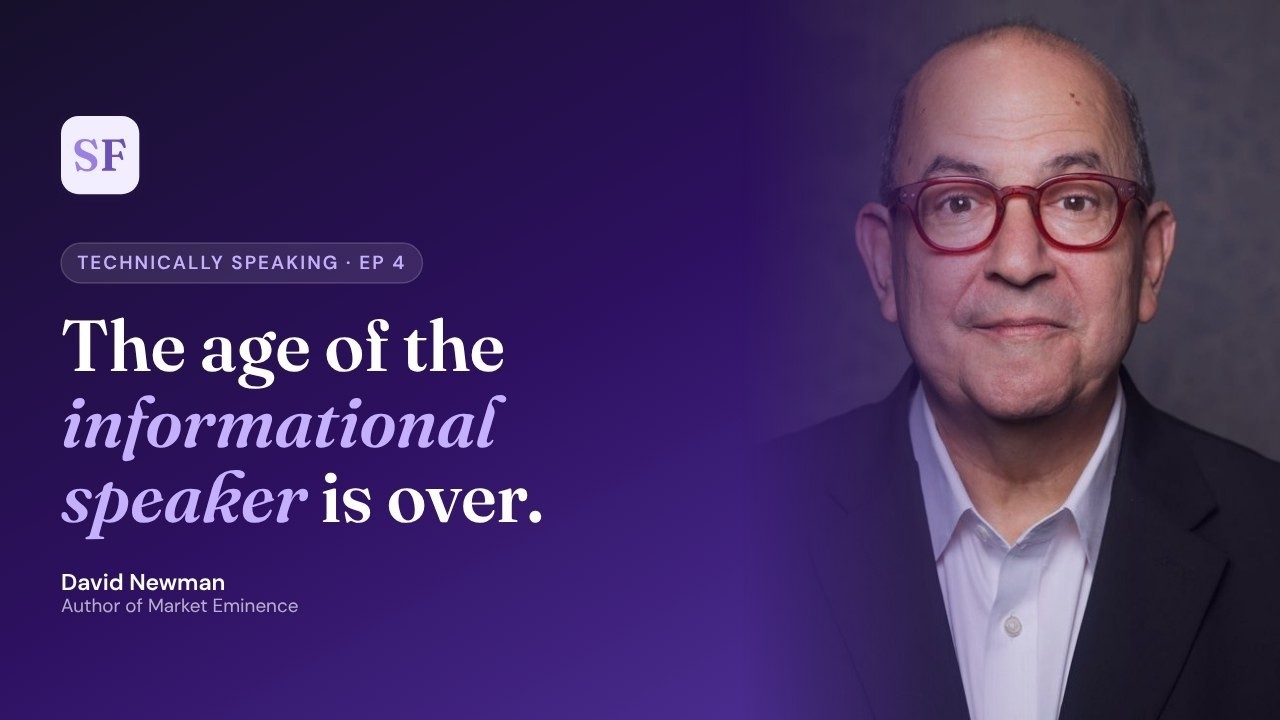
David: The age of the informational speaker is over. It is done. It is finished. Stick a fork in it. Nobody needs more information. No one needs more information from you. No one needs more information from me. Information has been commoditized because, with all of the AI tools, information is now instant, perfect, and free. Free if you count 20 bucks a month is free. Perfect if you don't worry about things like math or facts or dates, because it still gets those things wrong. But for most things, it's instant, perfect, and free. So, what does that leave you and me? What does that leave us? How can we be speakers in 2026, 2027, 2028, and beyond? There's an answer. I'm hoping that, Austin, you're like, "Newman, I hope there's an answer. I hope there's an answer to this." There is an answer to this. Stop sharing how-to and start sharing how to think.
David: How to think is still a uniquely human capability with your organic brain cells. So category number one: stop all the how-to. How-to is taken, how-to is done. How to think is a higher level, strategic, advisory-based set of opinions, perspectives, recommendations, biases based on your personal experience, your battle scars, your war stories, what you've done, what you've seen, what you've learned. Nobody can replicate that. AI cannot replicate that. The robots cannot replicate that. So that's how to think. The second thing is what to believe, and more important than what to believe is what not to believe. So we need to be problem solvers, but we also need to be mythbusters and truth tellers. That's our new value-added role in this second category.
David: So think about what you can do to separate the wheat from the chaff. What beliefs are no longer serving your audience or your target market? And then what beliefs are totally outdated? What truths are no longer truths? Or they're myths, or even worse, they're half-truths, which are just as dangerous, more dangerous, because they look like they're true sometimes. But what can you do to pop the bubble around these myths and tell the truth and call out the elephant in the room in your industry that people are dying for, because they see it, but they're just afraid to say it out loud? And think of all the things that you say behind closed doors with your team, with your clients, when you're doing a strategic work session. Things that you would never say in public because they're risky or they seem crazy or they seem dangerous or they seem like they're on the fringe, but you're sharing them with your clients because your clients are paying you the big bucks. Imagine if you shared them with the world before clients paid you money, and then people go, "My God, that's so true. That, I haven't even noticed that." So we need to be strategic thinkers, we need to be strategic problem solvers, and we need to be strategic belief shifters. So that's category two.
David: So we talked about no more how-to, focus on how to think, shift beliefs, what to believe, what not to believe. The third category that is uniquely human and AI proof is, how do I get ready for what's coming next? How can I see around corners? How can I be a trend spotter? How can I be a pattern recognizer? Now, Austin, you guys are great at doing this at SpeakerFlow, because every year you do this amazing survey. And so the 2026 survey is out now. Here is the X-ray vision into the industry. Here's what it takes to be successful three months, six months, nine months, twelve months down the road. Here's what you found through direct firsthand research that everyone else is still guessing about. So, what can you do, our listeners, our viewers, what can you do by way of original research, trend spotting, or pattern recognition to help people see around corners and see what's coming next? Because I'll tell you, high-level people hate being sideswiped, they hate being surprised by something that they could have seen coming, but nobody warned them of a danger and nobody told them of an opportunity.
David: So this is both positive and negative. It's not always monsters under the bed. This is a fantastic opportunity that your target market might be missing out on unless you point it out to them. Unless you make mention of, "Hey, this is coming. Here's how to get ahead of it. Here's how to take advantage. Here's how to be one of the first ones to jump on that pony." And if you do those three things, no more how-to, all focused on how to think. Number two, shift beliefs, what to believe, what not to believe. And then number three, how to get ready for what's coming next. A little trend spotting and future casting. You will be an AI proof speaker that people are falling all over themselves to hire. And you don't need a book for this, you don't need a fake AI video for this. You need visibility, respect, and then systems and processes and delegation to get this off your plate and out into the world consistently, day after day, week after week, month after month. That's how you make a name for yourself as a radically different, radically helpful, radically valuable resource that people would be lucky to have come to their meeting and speak.
Austin: People are lucky to have you on this planet, David. I'm like, this is... Yeah. People overcomplicate it so much. And the reality is, most of what you've been talking about here, obviously you're getting us a bunch of really practical here's-how-to-do-this kind of thing, but it's a headspace thing. It's the way people think about themselves and the value that they're creating for people and the way that they can serve. And one of my favorite things I'm always thinking about every time I process the data for the State of the Industry Report is that most of the things that I can point at that say, guaranteed, this is something that directly correlates with growth, is something that's not talent dependent. You don't have to be a special person to build systems. Anyone can build systems. And most people don't. That's the reality of it.
Austin: And so for those that are willing to take this seriously and commit to the business as a whole, it doesn't take all that much to get ahead of the vast majority of people that are not actively staying on top of this stuff, that are not executing on the thing. There's a lot of talk about it, but there's very few people that actually do it and do it consistently. And that's not a talent thing. It's a discipline thing. And anybody can get better at that. So I think most of what I'm hearing you say is, you don't have to be a special person to take what you're saying and do something with it. Literally anybody can do this if you actually do it. And the data says most won't. So I hope that, listeners, you're one of those people that will actually take what we're talking about here and execute it. 'Cause I can tell you that most of the other people that you're in competition with, let's say, just don't. That's what the data supports.
David: A thousand percent, a thousand percent. I think it was Joe Calloway at an NSA meeting maybe fifteen years ago. He's in the middle of some rant, he's saying the exact, here's what you do, here's how you do it, here's what you say, here's how you say it, and he stops himself and he says, "Have you ever wondered why all of the National Speakers Association's most successful members come to these meetings? They totally share absolutely every detail of their success and their business. And they do that so openly. Do you know why they do that?" And the audience is like, "Because generous, and spirit of NSA, and the..." He goes, "No, no, no. It's none of those things. It's, we know you're not gonna do anything with it. So it's completely safe to share it with you."
Austin: Woohoo, it's so true. That's so spicy, but it's so true. Yeah.
David: And so he threw down the gauntlet. He says, "I dare one of you to implement what I'm teaching you step by step today." And I don't think a single person in that room did.
Austin: Yeah. Well, so let's think about the person who's listening to this going, "I wanna be different. I wanna do something with this." Let's think about, I love the idea of habits as it relates to systems, because I feel like a proper system leads to a habit of some kind. And you know what, maybe sometimes the habit is being executed by technology, but it's a repeatable thing that's happening consistently. So if somebody's listening to this and they're like, "My gosh, I suck. I am bailing all of the things that David is saying right now." You have a client that comes to you and says that. What's something that you feel like you could do this week, Mr. Speaker, coach, consultant, trainer, author, podcaster, that will at least move them incrementally in that direction, that will give them some footing to build on?
David: Absolutely. So the easiest thing to do, this is one of the early chapters in the Market Eminence book. It's called Your Contrarian Slant. And I'm gonna summarize, because there's probably five or six different questions in that exercise, but I'll give you the top three. So to develop your contrarian slant, and then post something on LinkedIn, bring it into your next sales conversation, send out an email to your list about it, do something with it in the next 24 hours. Here's the three questions I want you to think about. Three questions I want you to answer. And you don't need to write a big long novel, just write down short phrases, keywords, bullets. Prompt number one, or question number one, is: what conventional wisdom in your field do you secretly think is completely wrong, but you've never publicly challenged it? Right? That's what I said about behind closed doors, elephant in the room, right? So think about that. Jot that down.
David: Second prompt to develop your contrarian slant, and this will be a combination of all three of these things, and you'll find more juice in one than the other, but that's okay. Number two is: what harsh truth about your industry are clients desperate for someone to finally acknowledge openly? So, something where there's a buzz, right? There's a groundswell of rebellion against this. So let's say, I'm just gonna make something up, if you're in the accounting industry, you want to rant against hourly billing, and hourly billing is like the sacred cow, and, "No, everyone does hourly billing, it's insane not to do hourly billing." Imagine if you came out with a whole series of rants, how hourly billing is terrible and toxic, and it hurts the firm, and it hurts the accountants, and it hurts the clients. And it causes overinflation of bills, and it causes projects to drag on too long. And wouldn't it be great to incentivize work that was perfect and quick, as opposed to imperfect? It needs a lot of rework and it takes way longer than it should, right? Because hourly billing is, well, the longer it takes, the more you pay. Honestly, most clients would say the shorter it takes, the more it's worth to me, right? The quicker it's over, the economic value goes up. So that could be something that you tackle. Think of a harsh truth in your industry. What would really shake the foundations of that industry?
David: Third prompt to develop your contrarian slant, that you can do this week and send out maybe tomorrow, is: what strong point of view do you already hold that makes other industry insiders uncomfortable but resonates deeply with your ideal clients? I call this the customer or client refugee story. So when clients come to you, right, they're typically complaining about what they just experienced, what they just came from. You're coming from one lawyer to another lawyer, you're coming from one software platform to another software platform, you just changed email service from service A to service B. They go, "Well, their delivery rate was terrible. You could never get through to customer service. It was always horrible when you talk to them. I knew more about the system than their engineers did." It's like, okay, all of that is rocket fuel, right? How can you now then become the hero in that industry, right? The competitors will be wetting their pants because they're like, "My God, he's calling out what's wrong with the industry." But all of the clients, all of the prospects are like, "My God, that's so much happened to me. That, totally, he is now singing my song. That's exactly what's wrong with my law firm. That's exactly what's wrong with my email service provider. That's exactly what's wrong with my automation platform. You ever feel like you're flying a starship, or you've got 17 million controls, yet nothing gets done because it's so complicated? And then instead of talking to a person, they go, 'Here, go into our 70,000 page self-help database.'"
David: I hate that. Yeah, I know you hate that. We all hate that. So, speakerflow.com. That's what I'm saying to you. So think about those three things, and I'll repeat them just for the sake of the assignment. Number one, conventional wisdom that in your field you secretly think is completely wrong, but you've never publicly challenged it. Couple bullets, couple of short phrases, keywords. Number two, what harsh truth in your industry are clients desperate for someone to finally acknowledge openly? So that's the elephant in the room question. And then the third one is the client refugee, customer refugee story. What do people come to you complaining about the previous guy, right? That your competitors would freak out if you started talking about that out loud, but all of your customers and all of your prospects would say, "My gosh, he is singing my song. That's totally what's going on with me." So what do you do with that? Today you write it up. And then tomorrow it's your LinkedIn post. Tomorrow it's the blog you're sending out. Tomorrow you bring that idea into your next sales conversation. Tomorrow you send out an email to all your subscribers that rant against that practice. And that will start you on the path of market eminence and true differentiation.
Austin: Ugh, so good. David, this and many more, twenty-two, if I remember correctly, twenty-two different strategies are in this book that you referenced, right? Your newest one, Market Eminence, right?
David: Yes. Market Eminence.
Austin: Please, listeners, I share resources constantly because I don't think that you can get too many perspectives about how to improve your business. There are very few people on this planet that I would beg you to read, and David is one of them. Please go read this book. There are so many people that I talk to that know that they need to improve their business and have very little vision for how to accomplish that. And this is a systems podcast. So much of what we're talking about here is the foundation that informs so many of the other areas of the business that we focus on. So please, everybody listening to this, go buy the book. It's what, marketeminence.com? Is that right? Cool.
David: marketeminence.com. That will take you to all the platforms: ebook, audio book, print book, whatever you like.
Austin: Great. And if somebody wants to talk to you directly, is that an option? I know you're a busy guy.
David: No, absolutely not. Never call me, never talk to me. I am a hermit. I'm on a desert island. I am way too busy.
Austin: Yeah, okay. Yeah, that makes sense. Yep. Yep. Okay, you've heard it here first, folks.
David: No, I'm kidding. The main website is doitmarketing.com, and my contact info is there, blog is there, podcast is there, all kinds of fun things, but just hit me up at the website, doitmarketing.com.